Vegetative Propagation of the Commercial Red Seaweed Chondracanthus chamissoi in Peru by Secondary Attachment Disc during Indoor Cultivation
| dc.contributor.author | Arbaiza, S. | |
| dc.contributor.author | Avila-Peltroche, J. | |
| dc.contributor.author | Castañeda-Franco, M. | |
| dc.contributor.author | Mires-Reyes, A. | |
| dc.contributor.author | Advíncula, O. | |
| dc.contributor.author | Baltazar, P. | |
| dc.date.accessioned | 2025-10-31T18:37:30Z | |
| dc.date.available | 2025-10-31T18:37:30Z | |
| dc.date.issued | 2023 | |
| dc.identifier.uri | https://hdl.handle.net/20.500.12805/5528 | |
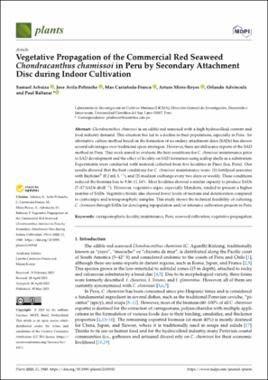
| dc.description.abstract | Chondracanthus chamissoi is an edible red seaweed with a high hydrocolloid content and food industry demand. This situation has led to a decline in their populations, especially in Peru. An alternative culture method based on the formation of secondary attachment discs (SADs) has shown several advantages over traditional spore strategies. However, there are still scarce reports of the SAD method in Peru. This work aimed to evaluate the best conditions for C. chamissoi maintenance prior to SAD development and the effect of locality on SAD formation using scallop shells as a substratum. Experiments were conducted with material collected from five localities in Pisco (Ica, Peru). Our results showed that the best conditions for C. chamissoi maintenance were: (1) fertilized seawater with Bayfolan® (0.2 mL L−1); and (2) medium exchange every two days or weekly. These conditions reduced the biomass loss to 9.36–11.14%. Most localities showed a similar capacity to produce SADs (7–17 SADs shell−1). However, vegetative algae, especially Mendieta, tended to present a higher number of SADs. Vegetative fronds also showed lower levels of necrosis and deterioration compared to cystocarpic and tetrasporophytic samples. This study shows the technical feasibility of culturing C. chamissoi through SADs for developing repopulation and/or intensive cultivation projects in Peru. | en_US |
| dc.description.sponsorship | This research was funded by Programa Nacional de Innovación en Pesca y Acuicultura (PNIPA), Nº 136-2018-PNIPA-Subproyectos “Implementation of a commercial pilot cultivation of Chondracanthus chamissoi by vegetative propagation in the Paracas Bay”, and Universidad Científica del Sur (UCSUR Nº 061-2022-PRO999). | |
| dc.format | application/pdf | |
| dc.language.iso | eng | |
| dc.publisher | MDPI | |
| dc.relation.ispartof | urn:issn:2223-7747 | |
| dc.rights | https://purl.org/coar/access_right/c_abf2 | |
| dc.rights.uri | https://creativecommons.org/licenses/by-nc-sa/4.0/ | |
| dc.subject | Marine Ecosystem Dynamics and Climate Resilience | en_US |
| dc.subject | Population Dynamics and Genetic Diversity in Rhodophyta | en_US |
| dc.title | Vegetative Propagation of the Commercial Red Seaweed Chondracanthus chamissoi in Peru by Secondary Attachment Disc during Indoor Cultivation | en_US |
| dc.type | https://purl.org/coar/resource_type/c_2df8fbb1 | |
| dc.identifier.doi | https://doi.org/10.3390/plants12101940 | |
| dc.subject.ocde | https://purl.org/pe-repo/ocde/ford#4.01.08 | |
| dc.type.other | Research article | |
| dc.identifier.journal | Plants | |
| dc.type.version | https://purl.org/coar/version/c_970fb48d4fbd8a85 |
Files in this item
This item appears in the following Collection(s)
-
Artículos de Investigación [1294]

Except where otherwise noted, this item's license is described as https://purl.org/coar/access_right/c_abf2