Differences in family functioning before and during the COVID-19 pandemic: an observational study in Peruvian families
| dc.contributor.author | Bazo-Alvarez, J.C. | |
| dc.contributor.author | Villarreal-Zegarra, D. | |
| dc.contributor.author | Lázaro-Illatopa, W.I. | |
| dc.contributor.author | Manrique-Millones, D. | |
| dc.contributor.author | Ipanaqué-Zapata, M. | |
| dc.contributor.author | Garcia, M.J. | |
| dc.contributor.author | Bazo-Alvarez, O. | |
| dc.contributor.author | Goicochea-Ríos, E. | |
| dc.contributor.author | Valle-Salvatierra, W. | |
| dc.contributor.author | García-Serna, J.E. | |
| dc.date.accessioned | 2025-10-31T18:37:23Z | |
| dc.date.available | 2025-10-31T18:37:23Z | |
| dc.date.issued | 2023 | |
| dc.identifier.uri | https://hdl.handle.net/20.500.12805/5515 | |
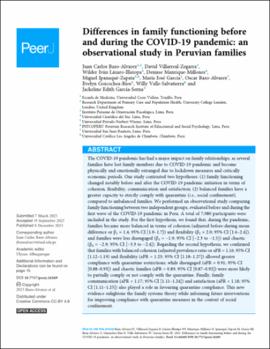
| dc.description.abstract | The COVID-19 pandemic has had a major impact on family relationships, as several families have lost family members due to COVID-19 pandemic and become physically and emotionally estranged due to lockdown measures and critically economic periods. Our study contrasted two hypotheses: (1) family functioning changed notably before and after the COVID-19 pandemic initiation in terms of cohesion, flexibility, communication and satisfaction; (2) balanced families have a greater capacity to strictly comply with quarantine (i.e., social confinement), compared to unbalanced families. We performed an observational study comparing family functioning between two independent groups, evaluated before and during the first wave of the COVID-19 pandemic in Peru. A total of 7,980 participants were included in the study. For the first hypothesis, we found that, during the pandemic, families became more balanced in terms of cohesion (adjusted before-during mean difference or β<inf>1</inf> = 1.4; 95% CI [1.0–1.7]) and flexibility (β<inf>2</inf> = 2.0; 95% CI [1.6–2.4]), and families were less disengaged (β<inf>3</inf> = −1.9; 95% CI [−2.3 to −1.5]) and chaotic (β<inf>4</inf> = −2.9; 95% CI [−3.3 to −2.4]). Regarding the second hypothesis, we confirmed that families with balanced cohesion (adjusted prevalence ratio or aPR = 1.16; 95% CI [1.12–1.19) and flexibility (aPR = 1.23; 95% CI [1.18–1.27]) allowed greater compliance with quarantine restrictions; while disengaged (aPR = 0.91; 95% CI [0.88–0.93]) and chaotic families (aPR = 0.89; 95% CI [0.87–0.92]) were more likely to partially comply or not comply with the quarantine. Finally, family communication (aPR = 1.17; 95% CI [1.11–1.24]) and satisfaction (aPR = 1.18; 95% CI [1.11–1.25]) also played a role in favouring quarantine compliance. This new evidence enlightens the family systems theory while informing future interventions for improving compliance with quarantine measures in the context of social confinement. | en_US |
| dc.format | application/pdf | |
| dc.language.iso | eng | |
| dc.publisher | PeerJ | |
| dc.relation.ispartof | urn:issn:2167-8359 | |
| dc.rights | https://purl.org/coar/access_right/c_abf2 | |
| dc.rights.uri | https://creativecommons.org/licenses/by-nc-sa/4.0/ | |
| dc.subject | SDG 3 | en_US |
| dc.subject | Dynamics of Interpersonal Relationships and Parenting Styles | en_US |
| dc.subject | Family Dynamics and Health Outcomes in Adolescents | en_US |
| dc.title | Differences in family functioning before and during the COVID-19 pandemic: an observational study in Peruvian families | en_US |
| dc.type | https://purl.org/coar/resource_type/c_2df8fbb1 | |
| dc.identifier.doi | https://doi.org/10.7717/peerj.16269 | |
| dc.subject.ocde | https://purl.org/pe-repo/ocde/ford#5.04.01 | |
| dc.type.other | Research article | |
| dc.identifier.journal | PeerJ | |
| dc.type.version | https://purl.org/coar/version/c_970fb48d4fbd8a85 |
Files in this item
This item appears in the following Collection(s)
-
Artículos de Investigación [1294]

Except where otherwise noted, this item's license is described as https://purl.org/coar/access_right/c_abf2