Impact of mini-driver genes in the prognosis and tumor features of colorectal cancer samples: a novel perspective to support current biomarkers
| dc.contributor.author | Segura, A.V.C. | |
| dc.contributor.author | Sotomayor, M.B.V. | |
| dc.contributor.author | Román, A.I.F.G. | |
| dc.contributor.author | Rojas, C.A.O. | |
| dc.contributor.author | Carrasco, A.G.M. | |
| dc.date.accessioned | 2025-10-31T18:37:21Z | |
| dc.date.available | 2025-10-31T18:37:21Z | |
| dc.date.issued | 2023 | |
| dc.identifier.uri | https://hdl.handle.net/20.500.12805/5511 | |
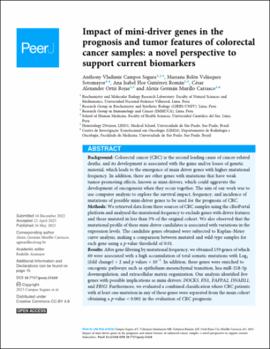
| dc.description.abstract | Background: Colorectal cancer (CRC) is the second leading cause of cancer-related deaths, and its development is associated with the gains and/or losses of genetic material, which leads to the emergence of main driver genes with higher mutational frequency. In addition, there are other genes with mutations that have weak tumor-promoting effects, known as mini-drivers, which could aggravate the development of oncogenesis when they occur together. The aim of our work was to use computer analysis to explore the survival impact, frequency, and incidence of mutations of possible mini-driver genes to be used for the prognosis of CRC. Methods: We retrieved data from three sources of CRC samples using the cBioPortal platform and analyzed the mutational frequency to exclude genes with driver features and those mutated in less than 5% of the original cohort. We also observed that the mutational profile of these mini-driver candidates is associated with variations in the expression levels. The candidate genes obtained were subjected to Kaplan-Meier curve analysis, making a comparison between mutated and wild-type samples for each gene using a p-value threshold of 0.01. Results: After gene filtering by mutational frequency, we obtained 159 genes of which 60 were associated with a high accumulation of total somatic mutations with Log<inf>2</inf> (fold change) > 2 and p values < 10−5. In addition, these genes were enriched to oncogenic pathways such as epithelium-mesenchymal transition, hsa-miR-218-5p downregulation, and extracellular matrix organization. Our analysis identified five genes with possible implications as mini-drivers: DOCK3, FN1, PAPPA2, DNAH11, and FBN2. Furthermore, we evaluated a combined classification where CRC patients with at least one mutation in any of these genes were separated from the main cohort obtaining a p-value < 0.001 in the evaluation of CRC prognosis. Conclusion: Our study suggests that the identification and incorporation of mini-driver genes in addition to known driver genes could enhance the accuracy of prognostic biomarkers for CRC. | en_US |
| dc.description.sponsorship | This work was supported by the Universidad Nacional Federico Villarreal (Lima, Peru) through Resolution No. 9343-2021-UNFV conceded to Anthony Vladimir Campos Segura and Prof. Ana Isabel Flor Gutiérrez Román as part of the incentives program for undergraduate thesis. The funders had no role in study design, data collection and analysis, decision to publish, or preparation of the manuscript. | |
| dc.format | application/pdf | |
| dc.language.iso | eng | |
| dc.publisher | PeerJ | |
| dc.relation.ispartof | urn:issn:2167-8359 | |
| dc.rights | https://purl.org/coar/access_right/c_abf2 | |
| dc.rights.uri | https://creativecommons.org/licenses/by-nc-sa/4.0/ | |
| dc.subject | SDG 3 | en_US |
| dc.subject | Melanoma Diagnosis and Treatment | en_US |
| dc.subject | Mutational Signatures and Driver Genes in Cancer | en_US |
| dc.title | Impact of mini-driver genes in the prognosis and tumor features of colorectal cancer samples: a novel perspective to support current biomarkers | en_US |
| dc.type | https://purl.org/coar/resource_type/c_2df8fbb1 | |
| dc.identifier.doi | https://doi.org/10.7717/peerj.15410 | |
| dc.subject.ocde | https://purl.org/pe-repo/ocde/ford#3.02.21 | |
| dc.type.other | Research article | |
| dc.identifier.journal | PeerJ | |
| dc.type.version | https://purl.org/coar/version/c_970fb48d4fbd8a85 |
Files in this item
This item appears in the following Collection(s)
-
Artículos de Investigación [1294]

Except where otherwise noted, this item's license is described as https://purl.org/coar/access_right/c_abf2