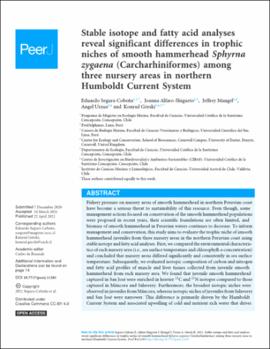
Stable isotope and fatty acid analyses reveal significant differences in trophic niches of smooth hammerhead Sphyrna zygaena (Carcharhiniformes) among three nursery areas in northern Humboldt Current System
| dc.contributor.author | Segura-Cobeña, E. | |
| dc.contributor.author | Alfaro-Shigueto, J. | |
| dc.contributor.author | Mangel, J. | |
| dc.contributor.author | Urzua, A. | |
| dc.contributor.author | Górski, K. | |
| dc.date.accessioned | 2025-10-31T18:37:20Z | |
| dc.date.available | 2025-10-31T18:37:20Z | |
| dc.date.issued | 2021 | |
| dc.identifier.uri | https://hdl.handle.net/20.500.12805/5510 | |
| dc.description.abstract | Fishery pressure on nursery areas of smooth hammerhead in northern Peruvian coast have become a serious threat to sustainability of this resource. Even though, some management actions focused on conservation of the smooth hammerhead populations were proposed in recent years, their scientific foundations are often limited, and biomass of smooth hammerhead in Peruvian waters continues to decrease. To inform management and conservation, this study aims to evaluate the trophic niche of smooth hammerhead juveniles from three nursery areas in the northern Peruvian coast using stable isotope and fatty acid analyses. First, we compared the environmental characteristics of each nursery area (i.e., sea surface temperature and chlorophyll-a concentration) and concluded that nursery areas differed significantly and consistently in sea surface temperature. Subsequently, we evaluated isotopic composition of carbon and nitrogen and fatty acid profiles of muscle and liver tissues collected from juvenile smooth hammerhead from each nursery area. We found that juvenile smooth hammerhead captured in San José were enriched in heavier 13C and 15N isotopes compared to those captured in Máncora and Salaverry. Furthermore, the broadest isotopic niches were observed in juveniles from Máncora, whereas isotopic niches of juveniles from Salaverry and San José were narrower. This difference is primarily driven by the Humboldt Current System and associated upwelling of cold and nutrient rich water that drives increased primary production in San José and, to a less extent, in Salaverry. Compared to smooth hammerhead juveniles from Máncora, those from San José and Salaverry were characterised by higher essential fatty acid concentrations related to pelagic and migratory prey. We conclude that smooth hammerhead juveniles from three nursery areas in the northern Peruvian coast differ significantly in their trophic niches. Thus, management and conservation efforts should consider each nursery area as a unique juvenile stock associated with a unique ecosystem and recognize the dependence of smooth hammerhead recruitment in San José and Salaverry on the productivity driven by the Humboldt Current System. | en_US |
| dc.description.sponsorship | This study was supported by Fondo para la Innovación, la Ciencia y la Tecnología (PIBA-369-2014) and Centro de Investigaciones en Biodiversidad y Ambientes Sustentables (CIBAS) of the UCSC. This study was performed with the support of Small Grant SOSF 521 from the Save Our Seas Foundation. The funders had no role in study design, data collection and analysis, decision to publish, or preparation of the manuscript. | |
| dc.format | application/pdf | |
| dc.language.iso | eng | |
| dc.publisher | PeerJ | |
| dc.relation.ispartof | urn:issn:2167-8359 | |
| dc.rights | https://purl.org/coar/access_right/c_abf2 | |
| dc.rights.uri | https://creativecommons.org/licenses/by-nc-sa/4.0/ | |
| dc.subject | SDG 6 | en_US |
| dc.subject | SDG 14 | en_US |
| dc.subject | Conservation Strategies for Endangered Marine Species | en_US |
| dc.subject | Conservation Strategies for Shark Populations and Fisheries | en_US |
| dc.title | Stable isotope and fatty acid analyses reveal significant differences in trophic niches of smooth hammerhead Sphyrna zygaena (Carcharhiniformes) among three nursery areas in northern Humboldt Current System | en_US |
| dc.type | https://purl.org/coar/resource_type/c_2df8fbb1 | |
| dc.identifier.doi | https://doi.org/10.7717/peerj.11283 | |
| dc.subject.ocde | https://purl.org/pe-repo/ocde/ford#1.06.12 | |
| dc.type.other | Research article | |
| dc.identifier.journal | PeerJ | |
| dc.type.version | https://purl.org/coar/version/c_970fb48d4fbd8a85 |
Files in this item
This item appears in the following Collection(s)
-
Artículos de Investigación [1294]

Except where otherwise noted, this item's license is described as https://purl.org/coar/access_right/c_abf2