Temperature–humidity index and reproductive performance of dairy cattle farms in Lima, Peru
| dc.contributor.author | Rolando, P.L. | |
| dc.contributor.author | Sandoval-Monzón, R.S. | |
| dc.contributor.author | Montenegro, M.P. | |
| dc.contributor.author | Ruiz-García, L.F. | |
| dc.date.accessioned | 2025-10-31T18:37:14Z | |
| dc.date.available | 2025-10-31T18:37:14Z | |
| dc.date.issued | 2022 | |
| dc.identifier.uri | https://hdl.handle.net/20.500.12805/5499 | |
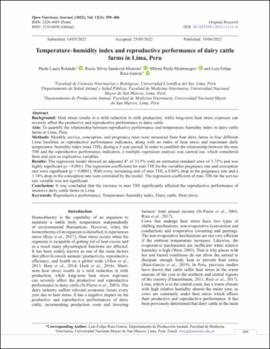
| dc.description.abstract | Background: Heat stress results in a mild reduction in milk production, while long-term heat stress exposure can severely affect the productive and reproductive performance in dairy cattle. Aim: To quantify the relationship between reproductive performance and temperature–humidity index in dairy cattle farms in Lima, Peru. Methods: Monthly service, conception, and pregnancy rates were measured from four dairy farms in four different Lima localities as reproductive performance indicators, along with an index of heat stress and maximum daily temperature–humidity index (max THI), during a 3-year period. In order to establish the relationship between the max THI and the reproductive performance indicators, a multiple regression analysis was carried out, which considered farm and year as explicative variables. Results: The regression model showed an adjusted R2 of 33.5% with an estimated standard error of 5.75% and was highly significant (p < 0.001). The regression coefficients for max THI for the variables pregnancy rate and conception rate were significant (p < 0.0001). With every increasing unit of max THI, a 0.84% drop in the pregnancy rate and a 1.74% drop in the conception rate were estimated by the model. The regression coefficient of max THI for the service rate variable was not significant. Conclusion: It was concluded that the increase in max THI significantly affected the reproductive performance of intensive dairy cattle farms in Lima. | en_US |
| dc.description.sponsorship | The authors would like to thank the Servicio Nacional de Meteorología e Hidrografía de Perú (SENAMHI) for providing meteorological data; as well as the farm owners and personnel for kindly facilitating the necessary information needed to perform the present study. | |
| dc.format | application/pdf | |
| dc.language.iso | eng | |
| dc.publisher | Faculty of Veterinary Medicine, University of Tripoli | |
| dc.relation.ispartof | urn:issn:2218-6050 | |
| dc.rights | https://purl.org/coar/access_right/c_abf2 | |
| dc.rights.uri | https://creativecommons.org/licenses/by-nc-sa/4.0/ | |
| dc.subject | Optimizing Poultry Production and Welfare Strategies | en_US |
| dc.subject | Heat Shock Response in Bovine Reproductive Health | en_US |
| dc.title | Temperature–humidity index and reproductive performance of dairy cattle farms in Lima, Peru | en_US |
| dc.type | https://purl.org/coar/resource_type/c_2df8fbb1 | |
| dc.identifier.doi | https://doi.org/10.5455/OVJ.2022.v12.i3.14 | |
| dc.subject.ocde | https://purl.org/pe-repo/ocde/ford#4.02.01 | |
| dc.type.other | Research article | |
| dc.identifier.journal | Open Veterinary Journal | |
| dc.type.version | https://purl.org/coar/version/c_970fb48d4fbd8a85 |
Files in this item
This item appears in the following Collection(s)
-
Artículos de Investigación [1294]

Except where otherwise noted, this item's license is described as https://purl.org/coar/access_right/c_abf2