Socioeconomic and Demographic Factors Associated with the Influence of the Food Traffic Light Labeling on the Decision of the Adult Population of Ecuador to Purchase Processed Foods, 2018
| dc.contributor.author | Bobbio Gonzáles, P.A. | |
| dc.contributor.author | Azañedo, D. | |
| dc.contributor.author | Hernández-Vásquez, A. | |
| dc.date.accessioned | 2025-10-31T18:37:03Z | |
| dc.date.available | 2025-10-31T18:37:03Z | |
| dc.date.issued | 2023 | |
| dc.identifier.uri | https://hdl.handle.net/20.500.12805/5477 | |
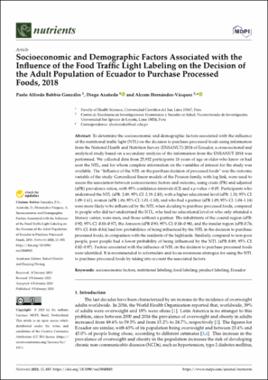
| dc.description.abstract | To determine the socioeconomic and demographic factors associated with the influence of the nutritional traffic light (NTL) on the decision to purchase processed foods using information from the National Health and Nutrition Survey (ENSANUT) 2018 of Ecuador, a cross-sectional and analytical study based on a secondary analysis of the information from the ENSANUT 2018 was performed. We collected data from 25,932 participants 18 years of age or older who knew or had seen the NTL, and for whom complete information on the variables of interest for the study was available. The “Influence of the NTL on the purchase decision of processed foods” was the outcome variable of the study. Generalized linear models of the Poisson family, with log link, were used to assess the association between socioeconomic factors and outcome, using crude (PR) and adjusted (aPR) prevalence ratios, with 95% confidence intervals (CI) and a p-value < 0.05. Participants who understood the NTL (aPR: 2.49; 95% CI: 2.19–2.83), with a higher educational level (aPR: 1.33; 95% CI: 1.09–1.61), women (aPR 1.06; 95% CI: 1.01–1.10), and who had a partner (aPR 1.09; 95% CI: 1.04–1.14) were more likely to be influenced by the NTL when deciding to purchase processed foods, compared to people who did not understand the NTL, who had no educational level or who only attended a literacy center, were men, and those without a partner. The inhabitants of the coastal region (aPR: 0.92; 95% CI: 0.88–0.97), the Amazon (aPR 0.93; 95% CI: 0.88–0.98), and the insular region (aPR 0.76; 95% CI: 0.68–0.84) had few probabilities of being influenced by the NTL in the decision to purchase processed foods, in comparison with the residents of the highlands. Similarly, compared to non-poor people, poor people had a lower probability of being influenced by the NTL (aPR 0.89; 95% CI: 0.82–0.97). Factors associated with the influence of NTL on the decision to purchase processed foods were identified. It is recommended to reformulate and focus awareness strategies for using the NTL to purchase processed foods by taking into account the associated factors. | en_US |
| dc.format | application/pdf | |
| dc.language.iso | eng | |
| dc.publisher | MDPI | |
| dc.relation.ispartof | urn:issn:2072-6643 | |
| dc.rights | https://purl.org/coar/access_right/c_abf2 | |
| dc.rights.uri | https://creativecommons.org/licenses/by-nc-sa/4.0/ | |
| dc.subject | Nutrition Patterns and Health Outcomes Across Cultures | en_US |
| dc.subject | Food Labeling Impact on Consumer Choices | en_US |
| dc.title | Socioeconomic and Demographic Factors Associated with the Influence of the Food Traffic Light Labeling on the Decision of the Adult Population of Ecuador to Purchase Processed Foods, 2018 | en_US |
| dc.type | https://purl.org/coar/resource_type/c_2df8fbb1 | |
| dc.identifier.doi | https://doi.org/10.3390/nu15040885 | |
| dc.subject.ocde | https://purl.org/pe-repo/ocde/ford#3.03.04 | |
| dc.type.other | Research article | |
| dc.identifier.journal | Nutrients | |
| dc.type.version | https://purl.org/coar/version/c_970fb48d4fbd8a85 |
Files in this item
This item appears in the following Collection(s)
-
Artículos de Investigación [1294]

Except where otherwise noted, this item's license is described as https://purl.org/coar/access_right/c_abf2