La poesía de José María Eguren y la literatura infantil
| dc.contributor.author | Sotomayor, A.M. | |
| dc.date.accessioned | 2025-10-31T18:36:46Z | |
| dc.date.available | 2025-10-31T18:36:46Z | |
| dc.date.issued | 2023 | |
| dc.identifier.uri | https://hdl.handle.net/20.500.12805/5450 | |
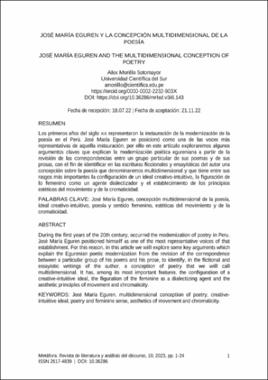
| dc.description.abstract | During the first years of the 20th century, occurred the modernization of poetry in Peru. José María Eguren positioned himself as one of the most representative voices of that establishment. For this reason, in this article we will explore some key arguments which explain the Egurenian poetic modernization from the revision of the correspondence between a particular group of his poems and his prose, to identify, in the fictional and essayistic writings of the author, a conception of poetry that we will call multidimensional. It has, among its most important features, the configuration of a creative-intuitive ideal, the figuration of the feminine as a dialectizing agent and the aesthetic principles of movement and chromaticity. | en_US |
| dc.format | application/pdf | |
| dc.language.iso | spa | |
| dc.publisher | Asociación Peruana de Retórica | |
| dc.relation.ispartof | urn:issn:2617-4839 | |
| dc.rights | https://purl.org/coar/access_right/c_abf2 | |
| dc.rights.uri | https://creativecommons.org/licenses/by-nc-sa/4.0/ | |
| dc.subject | Intersections of Literature, Philosophy, and Visual Arts | en_US |
| dc.subject | César Vallejo's Poetic Rhetoric and Cultural Memory | en_US |
| dc.title | La poesía de José María Eguren y la literatura infantil | es_PE |
| dc.type | https://purl.org/coar/resource_type/c_2df8fbb1 | |
| dc.identifier.doi | https://doi.org/10.36286/mrlad.v3i6.143 | |
| dc.subject.ocde | https://purl.org/pe-repo/ocde/ford#6.02.05 | |
| dc.type.other | Research article | |
| dc.identifier.journal | Metafora | |
| dc.type.version | https://purl.org/coar/version/c_970fb48d4fbd8a85 |
Files in this item
This item appears in the following Collection(s)
-
Artículos de Investigación [1294]

Except where otherwise noted, this item's license is described as https://purl.org/coar/access_right/c_abf2