Factors associated with knowledge of p-value in a sample of medical students
Abstract
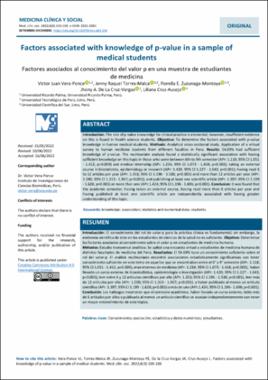
Introduction: The role of p-value knowledge for clinical practice is elemental; however, insufficient evidence on this is found in health science students. Objective: To determine the factors associated with p-value knowledge in human medical students. Methods: Analytical cross-sectional study. Application of a virtual survey to human medicine students from different faculties in Peru. Results: 54.69% had sufficient knowledge of p-value. The multivariate analysis found a statistically significant association with having sufficient knowledge on this topic in those who were between 6th to 9th semester (APr: 1.118; 95% CI 1.051-1.412; p=0.009) and medical internship (APr: 1.234; 95% CI 1.073-1.418; p=0.003); taking an external course in biostatistics, epidemiology or research (APr: 1.420; 95% CI 1.227-1.643; p<0.001); having read 6 to 12 articles per year (APr: 1.353; 95% CI 1.196-1.530; p<0.001) and more than 12 articles per year (APr: 1.590; 95% CI 1.313-1.967; p<0.001); and publishing at least one scientific article (APr: 1.397; 95% CI 1.199-1.628; p<0.001) or more than one (APr:1.424; 95% CI 1.196-1.696; p<0.001). Conclusion: It was found that the academic semester, having taken an external course, having read more than 6 articles per year and having published at least one scientific article are independently associated with having greater understanding of this topic.
Collections
- Artículos de Investigación [1294]

Except where otherwise noted, this item's license is described as https://purl.org/coar/access_right/c_abf2