NAT2 and CYP2E1 polymorphisms and antituberculosis drug-induced hepatotoxicity in Peruvian patients
| dc.contributor.author | Jaramillo-Valverde, L. | |
| dc.contributor.author | Levano, K.S. | |
| dc.contributor.author | Tarazona, D.D. | |
| dc.contributor.author | Capristano, S. | |
| dc.contributor.author | Zegarra-Chapoñan, R. | |
| dc.contributor.author | Sanchez, C. | |
| dc.contributor.author | Yufra-Picardo, V.M. | |
| dc.contributor.author | Tarazona-Santos, E. | |
| dc.contributor.author | Ugarte-Gil, C. | |
| dc.contributor.author | Guio, H. | |
| dc.date.accessioned | 2025-10-31T18:36:35Z | |
| dc.date.available | 2025-10-31T18:36:35Z | |
| dc.date.issued | 2022 | |
| dc.identifier.uri | https://hdl.handle.net/20.500.12805/5428 | |
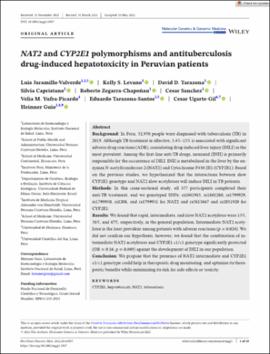
| dc.description.abstract | Background: In Peru, 32,970 people were diagnosed with tuberculosis (TB) in 2019. Although TB treatment is effective, 3.4%–13% is associated with significant adverse drug reactions (ADR), considering drug-induced liver injury (DILI) as the most prevalent. Among the first-line anti-TB drugs, isoniazid (INH) is primarily responsible for the occurrence of DILI. INH is metabolized in the liver by the enzymes N-acetyltransferase-2 (NAT2) and Cytochrome P450 2E1 (CYP2E1). Based on the previous studies, we hypothesized that the interactions between slow CYP2E1 genotype and NAT2 slow acetylators will induce DILI in TB patients. Methods: In this cross-sectional study, all 377 participants completed their anti-TB treatment, and we genotyped SNPs: rs1041983, rs1801280, rs1799929, rs1799930, rs1208, and rs1799931 for NAT2 and rs3813867 and rs2031920 for CYP2E1. Results: We found that rapid, intermediate, and slow NAT2 acetylator were 15%, 38%, and 47%, respectively, in the general population. Intermediate NAT2 acetylator is the least prevalent among patients with adverse reactions (p = 0.024). We did not confirm our hypothesis, however, we found that the combination of intermediate NAT2 acetylators and CYP2E1 c1/c1 genotype significantly protected (OR = 0.16; p = 0.049) against the development of DILI in our population. Conclusion: We propose that the presence of NAT2 intermediate and CYP2E1 c1/c1 genotype could help in therapeutic drug monitoring, and optimize its therapeutic benefits while minimizing its risk for side effects or toxicity. | en_US |
| dc.format | application/pdf | |
| dc.language.iso | eng | |
| dc.publisher | John Wiley and Sons | |
| dc.relation.ispartof | urn:issn:2324-9269 | |
| dc.rights | https://purl.org/coar/access_right/c_abf2 | |
| dc.rights.uri | https://creativecommons.org/licenses/by-nc-sa/4.0/ | |
| dc.subject | SDG 3 | en_US |
| dc.subject | Tuberculosis Treatment and Diagnostic Innovations | en_US |
| dc.subject | Hepatotoxicity Risks in Antituberculosis Treatment | en_US |
| dc.title | NAT2 and CYP2E1 polymorphisms and antituberculosis drug-induced hepatotoxicity in Peruvian patients | en_US |
| dc.type | https://purl.org/coar/resource_type/c_2df8fbb1 | |
| dc.identifier.doi | https://doi.org/10.1002/mgg3.1987 | |
| dc.subject.ocde | https://purl.org/pe-repo/ocde/ford#5.00.00 | |
| dc.type.other | Research article | |
| dc.identifier.journal | Molecular Genetics and Genomic Medicine | |
| dc.type.version | https://purl.org/coar/version/c_970fb48d4fbd8a85 |
Files in this item
This item appears in the following Collection(s)
-
Artículos de Investigación [1294]

Except where otherwise noted, this item's license is described as https://purl.org/coar/access_right/c_abf2