Metáforas, representación discursiva y migración venezolana en el Perú: hacia un análisis crítico-cognitivo del discurso de la prensa escrita peruana
| dc.contributor.author | Chenguayen, F.J.D. | |
| dc.contributor.author | Caceres, D.I.C. | |
| dc.contributor.author | Belen, M.A.M. | |
| dc.date.accessioned | 2025-10-31T18:36:27Z | |
| dc.date.available | 2025-10-31T18:36:27Z | |
| dc.date.issued | 2021 | |
| dc.identifier.uri | https://hdl.handle.net/20.500.12805/5412 | |
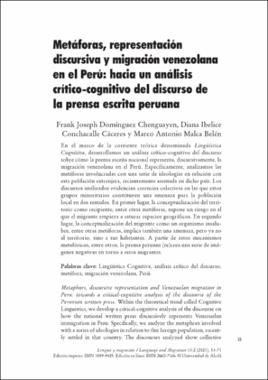
| dc.description.abstract | Metaphors, discursive representation and Venezuelan migration in Peru: towards a critical-cognitive analysis of the discourse of the Peruvian written press. Within the theoretical trend called Cognitive Linguistics, we develop a critical-cognitive analysis of the discourse on how the national written press discursively represents Venezuelan immigration in Peru. Specifically, we analyze the metaphors involved with a series of ideologies in relation to this foreign population, recently settled in that country. The discourses analyzed show collective beliefs in which these minority groups constitute a threat to the local population in two ways. In the first place, the conceptualization of the territory as a recipient, among other metaphors, implies a risk in which the migrant begins to saturate geographical spaces. Second, the conceptualization of the migrant as an unhealthy organism, among other metaphors, also implies a threat, but not to the territory, but to its inhabitants. From these metaphorical mechanisms, among others, the Peruvian press (re)creates a series of negative images around these migrants. | en_US |
| dc.description.abstract | En el marco de la corriente teórica denominada Lingüística Cognitiva, desarrollamos un análisis crítico-cognitivo del discurso sobre cómo la prensa escrita nacional representa, discursivamente, la migración venezolana en el Perú. Específicamente, analizamos las metáforas involucradas con una serie de ideologías en relación con esta población extranjera, recientemente asentada en dicho país. Los discursos analizados evidencian creencias colectivas en las que estos grupos minoritarios constituyen una amenaza para la población local en dos sentidos. En primer lugar, la conceptualización del territorio como recipiente, entre otras metáforas, supone un riesgo en el que el migrante empieza a saturar espacios geográficos. En segundo lugar, la conceptualización del migrante como un organismo insalubre, entre otras metáforas, implica también una amenaza, pero ya no al territorio, sino a sus habitantes. A partir de estos mecanismos metafóricos, entre otros, la prensa peruana (re)crea una serie de imágenes negativas en torno a estos migrantes. | es_PE |
| dc.format | application/pdf | |
| dc.language.iso | spa | |
| dc.publisher | Servicio de Publicaciones, Universidad de Alcalá | |
| dc.relation.ispartof | urn:issn:1889-5425 | |
| dc.rights | https://purl.org/coar/access_right/c_abf2 | |
| dc.rights.uri | https://creativecommons.org/licenses/by-nc-sa/4.0/ | |
| dc.subject | Pragmatic Discourse in Language and Media Contexts | en_US |
| dc.subject | Language and Power in Political Discourse | en_US |
| dc.title | Metáforas, representación discursiva y migración venezolana en el Perú: hacia un análisis crítico-cognitivo del discurso de la prensa escrita peruana | es_PE |
| dc.title.alternative | Metaforas, representacion discursiva y migration venezolana en el Peru: hacia un andlisis critico-cognitivo del discurso de la prensa escrita peruana | en_US |
| dc.type | https://purl.org/coar/resource_type/c_2df8fbb1 | |
| dc.identifier.doi | https://doi.org/10.37536/LYM.13.2.2021.1553 | |
| dc.subject.ocde | https://purl.org/pe-repo/ocde/ford#6.02.06 | |
| dc.type.other | Research article | |
| dc.identifier.journal | Lengua y Migración | |
| dc.type.version | https://purl.org/coar/version/c_970fb48d4fbd8a85 |
Files in this item
This item appears in the following Collection(s)
-
Artículos de Investigación [1294]

Except where otherwise noted, this item's license is described as https://purl.org/coar/access_right/c_abf2