Feeding ecology of the green turtle Chelonia mydas in northern Peru
| dc.contributor.author | Jiménez, A. | |
| dc.contributor.author | Pingo, S. | |
| dc.contributor.author | Alfaro-Shigueto, J. | |
| dc.contributor.author | Mangel, J.C. | |
| dc.contributor.author | Hooker, Y. | |
| dc.date.accessioned | 2025-10-31T18:36:26Z | |
| dc.date.available | 2025-10-31T18:36:26Z | |
| dc.date.issued | 2017 | |
| dc.identifier.uri | https://hdl.handle.net/20.500.12805/5410 | |
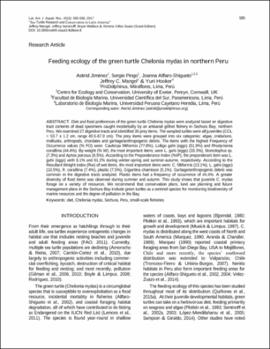
| dc.description.abstract | Diet and food preferences of the green turtle Chelonia mydas were analyzed based on digestive tract contents of dead specimens caught incidentally by an artisanal gillnet fishery in Sechura Bay, northern Peru. We examined 27 digestive tracts and identified 35 prey items. The sampled turtles were all juveniles (CCL = 53.7 ± 1.2 cm, range 40.5-67.0 cm). The prey items were grouped into six categories: algae, cnidarians, mollusks, arthropods, chordates and garbage/anthropogenic debris. The items with the highest Frequency of Occurrence values (% FO) were: Caulerpa filiformis (77.8%), Loligo gahi (eggs) (51.9%) and Rhodymenia corallina (44.4%). By weight (% W), the most important items, were L. gahi (eggs) (33.3%), Stomolophus sp. (7.3%) and Aphos porosus (6.5%). According to the Preponderance Index (%IP), the preponderant item was L. gahi (eggs) with 6.1% and 61.2% during winter-spring and summer-autumn, respectively. According to the Resultant Weight index (Rw) of wet items, the most important items were: C. filiformis (13.1%), L. gahi (eggs) (10.5%), R. corallina (7.4%), plastic (7.5%), Gigartina chamissoi (5.1%). Garbage/anthropogenic debris was common in the digestive tracts analyzed. Plastic items had a frequency of occurrence of 44.4%. A greater diversity of food items was observed during summer and autumn. This study shows that juvenile C. mydas forage on a variety of resources. We recommend that conservation plans, land use planning and future management plans in the Sechura Bay include green turtles as a sentinel species for monitoring biodiversity of marine resources and the degree of pollution in the Bay. | en_US |
| dc.description.sponsorship | We would like to thank the fishing communities who participated in this study. Our thanks also to biologists Armando Ugaz and Humberto Rivera (National University of Piura), David Montes (Ricardo Palma University) for their generous support during the project and for their help in identifying the samples collected. We also want to thank ProDelphinus staff for their help in data collection. This study was conducted with support from the National Fish and Wildlife Foundation (NFWF), Whitley Fund for Nature (WFN), Darwin Initiative - Sustainable Artisanal Fisheries Initiative in Peru (DEFRA), University of Exeter and ProDelphinus NGO. | |
| dc.format | application/pdf | |
| dc.language.iso | eng | |
| dc.publisher | Escuela de Ciencias del Mar | |
| dc.relation.ispartof | urn:issn:0718-560X | |
| dc.rights | https://purl.org/coar/access_right/c_abf2 | |
| dc.rights.uri | https://creativecommons.org/licenses/by-nc-sa/4.0/ | |
| dc.subject | SDG 14 | en_US |
| dc.subject | SDG 15 | en_US |
| dc.subject | Conservation Strategies for Endangered Marine Species | en_US |
| dc.subject | Conservation and Ecology of Sea Turtle Populations | en_US |
| dc.title | Feeding ecology of the green turtle Chelonia mydas in northern Peru | en_US |
| dc.type | https://purl.org/coar/resource_type/c_2df8fbb1 | |
| dc.identifier.doi | https://doi.org/10.3856/vol45-issue3-fulltext-8 | |
| dc.subject.ocde | https://purl.org/pe-repo/ocde/ford#1.06.13 | |
| dc.type.other | Research article | |
| dc.identifier.journal | Latin American Journal of Aquatic Research | |
| dc.type.version | https://purl.org/coar/version/c_970fb48d4fbd8a85 |
Files in this item
This item appears in the following Collection(s)
-
Artículos de Investigación [1294]

Except where otherwise noted, this item's license is described as https://purl.org/coar/access_right/c_abf2