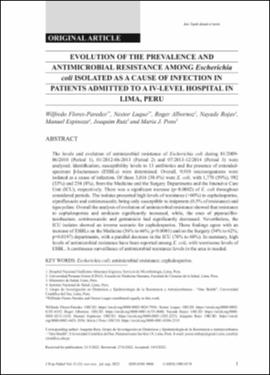
EVOLUTION OF THE PREVALENCE AND ANTIMICROBIAL RESISTANCE AMONG Escherichia coli ISOLATED AS A CAUSE OF INFECTION IN PATIENTS ADMITTED TO A IV-LEVEL HOSPITAL IN LIMA, PERU
| dc.contributor.author | Flores-Paredes, W. | |
| dc.contributor.author | Luque, N. | |
| dc.contributor.author | Albornoz, R. | |
| dc.contributor.author | Rojas, N. | |
| dc.contributor.author | Espinoza, M. | |
| dc.contributor.author | Ruiz, J. | |
| dc.contributor.author | Pons, M.J. | |
| dc.date.accessioned | 2025-10-31T18:36:20Z | |
| dc.date.available | 2025-10-31T18:36:20Z | |
| dc.date.issued | 2022 | |
| dc.identifier.uri | https://hdl.handle.net/20.500.12805/5397 | |
| dc.description.abstract | The levels and evolution of antimicrobial resistance of Escherichia coli during 01/2009-06/2010 (Period 1), 01/2012-06-2013 (Period 2) and 07/2013-12/2014 (Period 3) were analyzed. Identification, susceptibility levels to 13 antibiotics and the presence of extended-spectrum β-lactamases (ESBLs) were determined. Overall, 9,918 microorganisms were isolated as a cause of infection. Of these 3,016 (30.4%) were E. coli, with 1,770 (59%), 992 (33%) and 254 (8%), from the Medicine and the Surgery Departments and the Intensive Care Unit (ICU), respectively. There was a significant increase (p=0.0002) of E. coli throughout considered periods. The isolates presented high levels of resistance (>60%) to cephalosporins, ciprofloxacin and cotrimoxazole, being only susceptible to imipenem (0.3% of resistance) and tigecycline. Overall the analysis of evolution of antimicrobial resistance showed that resistance to cephalosporins and amikacin significantly increased, while, the ones of piperacillin-tazobactam, cotrimoxazole and gentamicin had significantly decreased. Nevertheless, the ICU isolates showed an inverse scenario for cephalosporins. These findings agree with an increase of ESBLs on the Medicine (56% to 66%; p<0.0001) and on the Surgery (54% to 62%; p=0.0197) departments, with a parallel decrease in the ICU (76% to 68%). In summary, high levels of antimicrobial resistance have been reported among E. coli, with worrisome levels of ESBL. A continuous surveillance of antimicrobial resistance levels in the area is needed. | en_US |
| dc.description.sponsorship | We thank Donna Pringle for the language correction. Funding: JR was supported by Fondo Nacional de Desarrollo Científico, Tecnológico y de Innovación Tecnológica (FONDECYT - Perú) and Universidad Científica del Sur within the “Proyecto de Mejoramiento y Ampliación de los Servicios del Sistema Nacional de Ciencia, Tecnología e Innovación Tecnológica” [contract: 08-2019-FONDECYT-BM-INC-INV”]. | |
| dc.format | application/pdf | |
| dc.language.iso | eng | |
| dc.publisher | Brazilian Society of Parasitology | |
| dc.relation.ispartof | urn:issn:0301-0406 | |
| dc.rights | https://purl.org/coar/access_right/c_abf2 | |
| dc.rights.uri | https://creativecommons.org/licenses/by-nc-sa/4.0/ | |
| dc.subject | Antibiotic Resistance Mechanisms in Clinical Infections | en_US |
| dc.subject | Resistance Mechanisms in Escherichia Coli and Klebsiella Pneumoniae | en_US |
| dc.title | EVOLUTION OF THE PREVALENCE AND ANTIMICROBIAL RESISTANCE AMONG Escherichia coli ISOLATED AS A CAUSE OF INFECTION IN PATIENTS ADMITTED TO A IV-LEVEL HOSPITAL IN LIMA, PERU | en_US |
| dc.type | https://purl.org/coar/resource_type/c_2df8fbb1 | |
| dc.identifier.doi | https://doi.org/10.5216/rpt.v51i3.74360 | |
| dc.subject.ocde | https://purl.org/pe-repo/ocde/ford#3.03.08 | |
| dc.type.other | Research article | |
| dc.identifier.journal | Journal of Tropical Pathology | |
| dc.type.version | https://purl.org/coar/version/c_970fb48d4fbd8a85 |
Files in this item
This item appears in the following Collection(s)
-
Artículos de Investigación [1294]

Except where otherwise noted, this item's license is described as https://purl.org/coar/access_right/c_abf2