An Explanatory Model of Work-family Conflict and Resilience as Predictors of Job Satisfaction in Nurses: The Mediating Role of Work Engagement and Communication Skills
| dc.contributor.author | Huaman, N. | |
| dc.contributor.author | Morales-García, W.C. | |
| dc.contributor.author | Castillo-Blanco, R. | |
| dc.contributor.author | Saintila, J. | |
| dc.contributor.author | Huancahuire-Vega, S. | |
| dc.contributor.author | Morales-García, S.B. | |
| dc.contributor.author | Calizaya-Milla, Y.E. | |
| dc.contributor.author | Palacios-Fonseca, A. | |
| dc.date.accessioned | 2025-10-31T18:36:12Z | |
| dc.date.available | 2025-10-31T18:36:12Z | |
| dc.date.issued | 2023 | |
| dc.identifier.uri | https://hdl.handle.net/20.500.12805/5381 | |
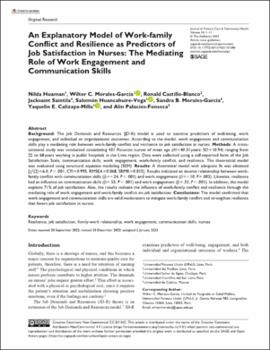
| dc.description.abstract | Background: The Job Demands and Resources (JD-R) model is used to examine predictors of well-being, work engagement, and individual or organizational outcomes. According to the model, work engagement and communication skills play a mediating role between work-family conflict and resilience to job satisfaction in nurses. Methods: A cross-sectional study was conducted considering 431 Peruvian nurses of mean age (M = 40.31 years; SD = 10.94) ranging from 22 to 68 years working in public hospitals in the Lima region. Data were collected using a self-reported form of the Job Satisfaction Scale, communication skills, work engagement, work-family conflict, and resilience. The theoretical model was evaluated using structural equation modeling (SEM). Results: A theoretical model with adequate fit was obtained [χ2(2) = 6.0, P <.001, CFI = 0.995, RMSEA = 0.068, SRMR = 0.015]. Results indicated an inverse relationship between work-family conflict with communication skills (β = −.24, P <.001) and work engagement (β = −.10, P =.003). Likewise, resilience had an influence on communication skills (β =.55, P <.001) and work engagement (β =.33, P <.001). In addition, the model explains 71% of job satisfaction. Also, the results indicate the influence of work-family conflict and resilience through the mediating role of work engagement and work-family conflict on job satisfaction. Conclusions: The model confirmed that work engagement and communication skills are valid moderators to mitigate work-family conflict and strengthen resilience that favors job satisfaction in nurses. | en_US |
| dc.format | application/pdf | |
| dc.language.iso | eng | |
| dc.publisher | GE Publications | |
| dc.relation.ispartof | urn:issn:2150-1327 | |
| dc.rights | https://purl.org/coar/access_right/c_abf2 | |
| dc.rights.uri | https://creativecommons.org/licenses/by-nc-sa/4.0/ | |
| dc.subject | Emotional Labor and Job Satisfaction in Workplaces | en_US |
| dc.subject | Employee Engagement and Job Crafting Dynamics | en_US |
| dc.title | An Explanatory Model of Work-family Conflict and Resilience as Predictors of Job Satisfaction in Nurses: The Mediating Role of Work Engagement and Communication Skills | en_US |
| dc.type | https://purl.org/coar/resource_type/c_2df8fbb1 | |
| dc.identifier.doi | https://doi.org/10.1177/21501319231151380 | |
| dc.subject.ocde | https://purl.org/pe-repo/ocde/ford#3.03.03 | |
| dc.type.other | Research article | |
| dc.identifier.journal | Journal of Primary Care and Community Health | |
| dc.type.version | https://purl.org/coar/version/c_970fb48d4fbd8a85 |
Files in this item
This item appears in the following Collection(s)
-
Artículos de Investigación [1294]

Except where otherwise noted, this item's license is described as https://purl.org/coar/access_right/c_abf2