Multimorbidity and Disability Among Venezuelan Migrants: A Population-Based Survey in Peru
| dc.contributor.author | Bernabe-Ortiz, A. | |
| dc.contributor.author | Carrillo-Larco, R.M. | |
| dc.date.accessioned | 2025-10-31T18:35:49Z | |
| dc.date.available | 2025-10-31T18:35:49Z | |
| dc.date.issued | 2022 | |
| dc.identifier.uri | https://hdl.handle.net/20.500.12805/5334 | |
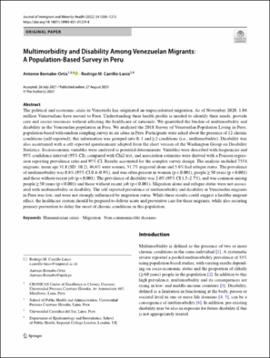
| dc.description.abstract | The political and economic crisis in Venezuela has originated an unprecedented migration. As of November 2020, 1.04 million Venezuelans have moved to Peru. Understanding their health profile is needed to identify their needs, provide care and secure resources without affecting the healthcare of nationals. We quantified the burden of multimorbidity and disability in the Venezuelan population in Peru. We analyzed the 2018 Survey of Venezuelan Population Living in Peru; population-based with random sampling survey in six cities in Peru. Participants were asked about the presence of 12 chronic conditions (self-reported); this information was grouped into 0, 1 and ≥ 2 conditions (i.e., multimorbidity). Disability was also ascertained with a self-reported questionnaire adapted from the short version of the Washington Group on Disability Statistics. Socioeconomic variables were analyzed as potential determinants. Variables were described with frequencies and 95% confidence interval (95% CI), compared with Chi2 test, and association estimates were derived with a Poisson regression reporting prevalence ratio and 95% CI. Results accounted for the complex survey design. The analysis included 7554 migrants, mean age 31.8 (SD: 10.2), 46.6% were women, 31.7% migrated alone and 5.6% had refugee status. The prevalence of multimorbidity was 0.6% (95% CI 0.4–0.9%), and was often present in women (p < 0.001), people ≥ 50 years (p < 0.001) and those without recent job (p < 0.001). The prevalence of disability was 2.0% (95% CI 1.5–2.7%), and was common among people ≥ 50 years (p < 0.001) and those without recent job (p < 0.001). Migration alone and refugee status were not associated with multimorbidity or disability. The self-reported prevalence of multimorbidity and disability in Venezuelan migrants in Peru was low, and were not strongly influenced by migration status. While these results could suggest a healthy migrant effect, the healthcare system should be prepared to deliver acute and preventive care for these migrants, while also securing primary prevention to delay the onset of chronic conditions in this population. | en_US |
| dc.description.sponsorship | Rodrigo M. Carrillo-Larco is supported by a Wellcome Trust International Training Fellowship (214185/Z/18/Z). | |
| dc.format | application/pdf | |
| dc.language.iso | eng | |
| dc.publisher | Springer | |
| dc.relation.ispartof | urn:issn:1557-1912 | |
| dc.rights | https://purl.org/coar/access_right/c_abf2 | |
| dc.rights.uri | https://creativecommons.org/licenses/by-nc-sa/4.0/ | |
| dc.subject | SDG 3 | en_US |
| dc.subject | SDG 10 | en_US |
| dc.subject | Integrated Care Models for Chronic Health Management | en_US |
| dc.subject | Multimorbidity Management in Chronic Disease Care | en_US |
| dc.title | Multimorbidity and Disability Among Venezuelan Migrants: A Population-Based Survey in Peru | en_US |
| dc.type | https://purl.org/coar/resource_type/c_2df8fbb1 | |
| dc.identifier.doi | https://doi.org/10.1007/s10903-021-01259-8 | |
| dc.subject.ocde | https://purl.org/pe-repo/ocde/ford#3.03.05 | |
| dc.type.other | Research article | |
| dc.identifier.journal | Journal of Immigrant and Minority Health | |
| dc.type.version | https://purl.org/coar/version/c_970fb48d4fbd8a85 |
Files in this item
This item appears in the following Collection(s)
-
Artículos de Investigación [1294]

Except where otherwise noted, this item's license is described as https://purl.org/coar/access_right/c_abf2