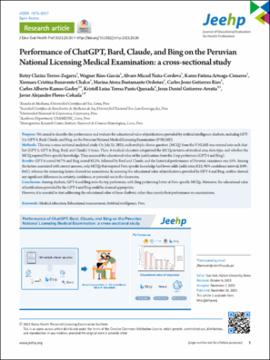
Performance of ChatGPT, Bard, Claude, and Bing on the Peruvian National Licensing Medical Examination: a cross-sectional study
| dc.contributor.author | Torres-Zegarra, B.C. | |
| dc.contributor.author | Rios-Garcia, W. | |
| dc.contributor.author | Ñaña-Cordova, A.M. | |
| dc.contributor.author | Arteaga-Cisneros, K.F. | |
| dc.contributor.author | Benavente Chalco, X.C. | |
| dc.contributor.author | Bustamante Ordoñez, M.A. | |
| dc.contributor.author | Gutierrez Rios, C.J. | |
| dc.contributor.author | Ramos Godoy, C.A. | |
| dc.contributor.author | Teresa Panta Quezada, K.L. | |
| dc.contributor.author | Gutierrez-Arratia, J.D. | |
| dc.contributor.author | Flores-Cohaila, J.A. | |
| dc.date.accessioned | 2025-10-31T18:35:46Z | |
| dc.date.available | 2025-10-31T18:35:46Z | |
| dc.date.issued | 2023 | |
| dc.identifier.uri | https://hdl.handle.net/20.500.12805/5326 | |
| dc.description.abstract | Purpose: We aimed to describe the performance and evaluate the educational value of justifications provided by artificial intelligence chatbots, including GPT-3.5, GPT-4, Bard, Claude, and Bing, on the Peruvian National Medical Licensing Examination (P-NLME). Methods: This was a cross-sectional analytical study. On July 25, 2023, each multiple-choice question (MCQ) from the P-NLME was entered into each chatbot (GPT-3, GPT-4, Bing, Bard, and Claude) 3 times. Then, 4 medical educators categorized the MCQs in terms of medical area, item type, and whether the MCQ required Peru-specific knowledge. They assessed the educational value of the justifications from the 2 top performers (GPT-4 and Bing). Results: GPT-4 scored 86.7% and Bing scored 82.2%, followed by Bard and Claude, and the historical performance of Peruvian examinees was 55%. Among the factors associated with correct answers, only MCQs that required Peru-specific knowledge had lower odds (odds ratio, 0.23; 95% confidence interval, 0.09–0.61), whereas the remaining factors showed no associations. In assessing the educational value of justifications provided by GPT-4 and Bing, neither showed any significant differences in certainty, usefulness, or potential use in the classroom. Conclusion: Among chatbots, GPT-4 and Bing were the top performers, with Bing performing better at Peru-specific MCQs. Moreover, the educational value of justifications provided by the GPT-4 and Bing could be deemed appropriate. However, it is essential to start addressing the educational value of these chatbots, rather than merely their performance on examinations. | en_US |
| dc.format | application/pdf | |
| dc.language.iso | eng | |
| dc.publisher | Korea Health Personnel Licensing Examination Institute | |
| dc.relation.ispartof | urn:issn:1975-5937 | |
| dc.rights | https://purl.org/coar/access_right/c_abf2 | |
| dc.rights.uri | https://creativecommons.org/licenses/by-nc-sa/4.0/ | |
| dc.subject | SDG 3 | en_US |
| dc.subject | Psychometrics and Rasch Analysis in Education Assessment | en_US |
| dc.subject | Automatic Item Generation for Assessment | en_US |
| dc.title | Performance of ChatGPT, Bard, Claude, and Bing on the Peruvian National Licensing Medical Examination: a cross-sectional study | en_US |
| dc.type | https://purl.org/coar/resource_type/c_2df8fbb1 | |
| dc.identifier.doi | https://doi.org/10.3352/jeehp.2023.20.30 | |
| dc.subject.ocde | https://purl.org/pe-repo/ocde/ford#3.00.00 | |
| dc.type.other | Research article | |
| dc.identifier.journal | Journal of Educational Evaluation for Health Professions | |
| dc.type.version | https://purl.org/coar/version/c_970fb48d4fbd8a85 |
Files in this item
This item appears in the following Collection(s)
-
Artículos de Investigación [1294]

Except where otherwise noted, this item's license is described as https://purl.org/coar/access_right/c_abf2