Prevalence of impacted teeth and supernumerary teeth by radiographic evaluation in three Latin American countries: A cross-sectional study
| dc.contributor.author | Tetay-Salgado, S. | |
| dc.contributor.author | Arriola-Guillén, L.-E. | |
| dc.contributor.author | Ruíz-Mora, G.-A. | |
| dc.contributor.author | Castillo, A.A.-D. | |
| dc.contributor.author | Rodríguez-Cárdenas, Y.-A. | |
| dc.date.accessioned | 2025-10-31T18:35:31Z | |
| dc.date.available | 2025-10-31T18:35:31Z | |
| dc.date.issued | 2021 | |
| dc.identifier.uri | https://hdl.handle.net/20.500.12805/5294 | |
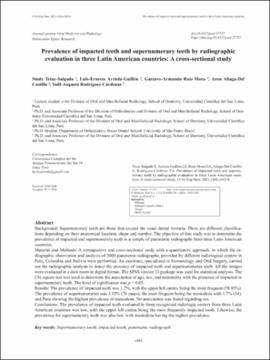
| dc.description.abstract | Background: Supernumerary teeth are those that exceed the usual dental formula. There are different classifications depending on their anatomical location, shape and number. The objective of this study was to determine the prevalence of impacted and supernumerary teeth in a sample of panoramic radiographs from three Latin American countries. Material and Methods: A retrospective and cross-sectional study with a quantitative approach, in which the radiographic observation and analysis of 2000 panoramic radiographs, provided by different radiological centers in Peru, Colombia and Bolivia were performed. An examiner, specialized in Stomatology and Oral Surgery, carried out the radiographic analysis to detect the presence of impacted teeth and supernumeraries teeth. All the images were evaluated in a dark room in digital format. The SPSS version 23 package was used for statistical analysis. The Chi-square test was used to determine the association of age, sex, and nationality with the presence of impacted or supernumerary teeth. The level of significance was p< 0.05. Results: The prevalence of impacted teeth was 1.7%, with the upper left canine being the most frequent (58.85%). The prevalence of supernumeraries was 3.15% (76 cases), the most frequent being the mesiodens with 1.7% (34), and Peru showing the highest prevalence of mesiodens. No association was found regarding sex. Conclusions: The prevalence of impacted teeth evaluated in three recognized radiologic centers from three Latin American countries was low, with the upper left canine being the most frequently impacted tooth. Likewise, the prevalence for supernumerary teeth was also low, with mesiodens having the highest prevalence. | en_US |
| dc.format | application/pdf | |
| dc.language.iso | eng | |
| dc.publisher | Medicina Oral | |
| dc.relation.ispartof | urn:issn:1989-5488 | |
| dc.rights | https://purl.org/coar/access_right/c_abf2 | |
| dc.rights.uri | https://creativecommons.org/licenses/by-nc-sa/4.0/ | |
| dc.subject | Cleft Lip and Palate Treatment Innovations | en_US |
| dc.subject | Supernumerary Teeth and Their Implications | en_US |
| dc.title | Prevalence of impacted teeth and supernumerary teeth by radiographic evaluation in three Latin American countries: A cross-sectional study | en_US |
| dc.type | https://purl.org/coar/resource_type/c_2df8fbb1 | |
| dc.identifier.doi | https://doi.org/10.4317/jced.57757 | |
| dc.subject.ocde | https://purl.org/pe-repo/ocde/ford#3.02.14 | |
| dc.type.other | Research article | |
| dc.identifier.journal | Journal of Clinical and Experimental Dentistry | |
| dc.type.version | https://purl.org/coar/version/c_970fb48d4fbd8a85 |
Files in this item
This item appears in the following Collection(s)
-
Artículos de Investigación [1294]

Except where otherwise noted, this item's license is described as https://purl.org/coar/access_right/c_abf2