The uropygial gland microbiome of house sparrows with malaria infection
| dc.contributor.author | Videvall, E. | |
| dc.contributor.author | Marzal, A. | |
| dc.contributor.author | Magallanes, S. | |
| dc.contributor.author | Fleischer, R.C. | |
| dc.contributor.author | Espinoza, K. | |
| dc.contributor.author | García-Longoria, L. | |
| dc.date.accessioned | 2025-10-31T18:35:28Z | |
| dc.date.available | 2025-10-31T18:35:28Z | |
| dc.date.issued | 2021 | |
| dc.identifier.uri | https://hdl.handle.net/20.500.12805/5287 | |
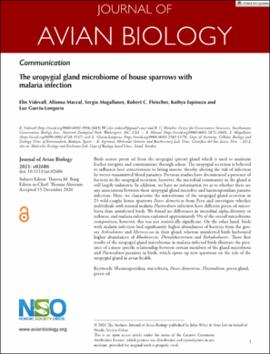
| dc.description.abstract | Birds secrete preen oil from the uropygial (preen) gland which is used to maintain feather integrity and communicate through odour. The uropygial secretion is believed to influence host attractiveness to biting insects, thereby altering the risk of infection by vector-transmitted blood parasites. Previous studies have documented a presence of bacteria in the uropygial secretion; however, the microbial community in the gland is still largely unknown. In addition, we have no information yet as to whether there are any associations between these uropygial gland microbes and haemosporidian parasite infection. Here, we characterise the microbiome of the uropygial gland secretion in 23 wild-caught house sparrows Passer domesticus from Peru and investigate whether individuals with natural malaria Plasmodium infection have different preen oil microbiota than uninfected birds. We found no differences in microbial alpha diversity or richness, and malaria infection explained approximately 5% of the overall microbiome composition, however, this was not statistically significant. On the other hand, birds with malaria infection had significantly higher abundances of bacteria from the genera Arthrobacter and Micrococcus in their gland, whereas uninfected birds harboured higher abundances of Rhodococcus, Phenylobacterium and Enhydrobacter. These first results of the uropygial gland microbiome in malaria-infected birds illustrate the presence of a more specific relationship between certain members of the gland microbiota and Plasmodium parasites in birds, which opens up new questions on the role of the uropygial gland in avian health. | en_US |
| dc.description.sponsorship | Funding text 1: – This study was supported by grants from the Spanish Ministry of Economy and Competition (CGL2015‐64650P) (to A.M. and S.M.), Junta de Extremadura (GR18047 research group BBB028 and IB16121) (to A.M.). L.G.L. was supported by a postdoctoral grant (PO17024) from Consejería de Educación y Empleo of Junta de Extremadura. E.V. was supported by a grant from the National Science Foundation (DEB‐1717498) to R.C.F. Funding; Funding text 2: – We thank Wendy C. Saavedra and Charlene Lujan‐Vega for their invaluable assistance during fieldwork. We are grateful to technical and human support provided by Facility of Bioscience Applied Techniques of SAIUEx (financed by UEX, Junta de Extremadura, MICINN, FEDER and FSE). Acknowledgements | |
| dc.format | application/pdf | |
| dc.language.iso | eng | |
| dc.publisher | Blackwell Publishing | |
| dc.relation.ispartof | urn:issn:1600-048X | |
| dc.rights | https://purl.org/coar/access_right/c_abf2 | |
| dc.rights.uri | https://creativecommons.org/licenses/by-nc-sa/4.0/ | |
| dc.subject | SDG 3 | en_US |
| dc.subject | Interplay of Behavior and Coloration in Species | en_US |
| dc.subject | Olfactory Communication and Microbial Interactions in Birds | en_US |
| dc.title | The uropygial gland microbiome of house sparrows with malaria infection | en_US |
| dc.type | https://purl.org/coar/resource_type/c_2df8fbb1 | |
| dc.identifier.doi | https://doi.org/10.1111/jav.02686 | |
| dc.subject.ocde | https://purl.org/pe-repo/ocde/ford#1.06.01 | |
| dc.type.other | Research article | |
| dc.identifier.journal | Journal of Avian Biology | |
| dc.type.version | https://purl.org/coar/version/c_970fb48d4fbd8a85 |
Files in this item
This item appears in the following Collection(s)
-
Artículos de Investigación [1294]

Except where otherwise noted, this item's license is described as https://purl.org/coar/access_right/c_abf2