Polymerization Kinetics, Shrinkage Stress, and Bond Strength to Dentin of Conventional and Self-adhesive Resin Cements
| dc.contributor.author | Nima, G. | |
| dc.contributor.author | Makishi, P. | |
| dc.contributor.author | Fronza, B.M. | |
| dc.contributor.author | Ferreira, P.V.C. | |
| dc.contributor.author | Braga, R.R. | |
| dc.contributor.author | Reis, A.F. | |
| dc.contributor.author | Giannini, M. | |
| dc.date.accessioned | 2025-10-31T18:35:26Z | |
| dc.date.available | 2025-10-31T18:35:26Z | |
| dc.date.issued | 2022 | |
| dc.identifier.uri | https://hdl.handle.net/20.500.12805/5283 | |
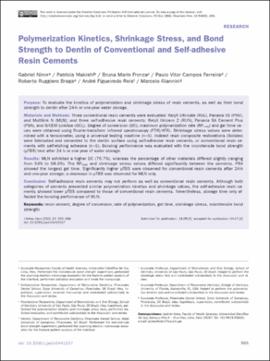
| dc.description.abstract | Purpose: To evaluate the kinetics of polymerization and shrinkage stress of resin cements, as well as their bond strength to dentin after 24-h or one-year water storage. Materials and Methods: Three conventional resin cements were evaluated: RelyX Ultimate (RUL), Panavia V5 (PNV), and Multilink N (MLN); and three self-adhesive resin cements: RelyX Unicem 2 (RUN), Panavia SA Cement Plus (PSA), and G-CEM LinkAce (GCL). Degree of conversion (DC), maximum polymerization rate (RP<inf>max</inf>) and gel time va ues were obtained using Fourier-transform infrared spectroscopy (FTIR/ATR). Shrinkage stress values were deter mined with a tensiometer, using a universal testing machine (n=5). Indirect resin composite restorations (Solidex) were fabricated and cemented to the dentin surface using self-adhesive resin cements, or conventional resin ce ments with self-etching adhesive (n=5). Bonding performance was evaluated with the microtensile bond strength (μTBS) test after 24 h or one year of water storage. Results: MLN exhibited a higher DC (76.7%), whereas the percentage of other materials differed slightly (ranging from 54% to 58.5%). The RPm and shrinkage stress values differed significantly between the cements. PSA showed the longest gel time. Significantly higher μTBS were observed for conventional resin cements after 24-h and one-year storage; a decrease in μTBS was observed for MLN only. Conclusion: Self-adhesive resin cements may not perform as well as conventional resin cements. Although both categories of cements presented similar polymerization kinetics and shrinkage values, the self-adhesive resin ce ments showed lower μTBS compared to those of conventional resin cements. Nevertheless, storage time only af fected the bonding performance of MLN | en_US |
| dc.description.sponsorship | Funding text 1: This work was supported by a grant from the Brazilian Federal Gov ernment Agency, Ministry of Education, Coordination for the Improve ment of Higher Education Personnel (CAPES No. 878/2014) and by the Brazilian National Council for Scientific and Technological Devel opment (CNPq No. 304692/2018-2); Funding text 2: This work was supported by a grant from the Brazilian Federal Government Agency, Ministry of Education, Coordination for the Improvement of Higher Education Personnel (CAPES No. 878/2014) and by the Brazilian National Council for Scientific and Technological Development (CNPq No. 304692/2018-2). | |
| dc.format | application/pdf | |
| dc.language.iso | eng | |
| dc.publisher | Quintessence Publishing | |
| dc.relation.ispartof | urn:issn:1757-9988 | |
| dc.rights | https://purl.org/coar/access_right/c_abf2 | |
| dc.rights.uri | https://creativecommons.org/licenses/by-nc-sa/4.0/ | |
| dc.subject | Mechanical Strength and Bonding in Dental Materials | en_US |
| dc.subject | Dental Composite Resin Materials | en_US |
| dc.title | Polymerization Kinetics, Shrinkage Stress, and Bond Strength to Dentin of Conventional and Self-adhesive Resin Cements | en_US |
| dc.type | https://purl.org/coar/resource_type/c_2df8fbb1 | |
| dc.identifier.doi | https://doi.org/10.3290/j.jad.b3441537 | |
| dc.subject.ocde | https://purl.org/pe-repo/ocde/ford#3.02.14 | |
| dc.type.other | Research article | |
| dc.identifier.journal | Journal of Adhesive Dentistry | |
| dc.type.version | https://purl.org/coar/version/c_970fb48d4fbd8a85 |
Files in this item
This item appears in the following Collection(s)
-
Artículos de Investigación [1294]

Except where otherwise noted, this item's license is described as https://purl.org/coar/access_right/c_abf2