Performance of ChatGPT on the Peruvian National Licensing Medical Examination: Cross-Sectional Study
| dc.contributor.author | Flores-Cohaila, J.A. | |
| dc.contributor.author | García-Vicente, A. | |
| dc.contributor.author | Vizcarra-Jiménez, S.F. | |
| dc.contributor.author | De la Cruz-Galán, J.P. | |
| dc.contributor.author | Gutiérrez-Arratia, J.D. | |
| dc.contributor.author | Quiroga Torres, B.G. | |
| dc.contributor.author | Taype-Rondan, A. | |
| dc.date.accessioned | 2025-10-31T18:35:25Z | |
| dc.date.available | 2025-10-31T18:35:25Z | |
| dc.date.issued | 2023 | |
| dc.identifier.uri | https://hdl.handle.net/20.500.12805/5281 | |
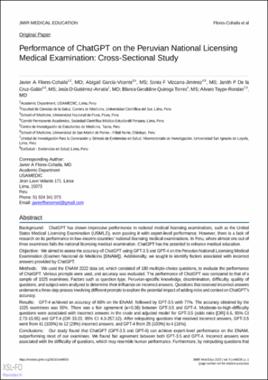
| dc.description.abstract | Background: ChatGPT has shown impressive performance in national medical licensing examinations, such as the United States Medical Licensing Examination (USMLE), even passing it with expert-level performance. However, there is a lack of research on its performance in low-income countries’ national licensing medical examinations. In Peru, where almost one out of three examinees fails the national licensing medical examination, ChatGPT has the potential to enhance medical education. Objective: We aimed to assess the accuracy of ChatGPT using GPT-3.5 and GPT-4 on the Peruvian National Licensing Medical Examination (Examen Nacional de Medicina [ENAM]). Additionally, we sought to identify factors associated with incorrect answers provided by ChatGPT. Methods: We used the ENAM 2022 data set, which consisted of 180 multiple-choice questions, to evaluate the performance of ChatGPT. Various prompts were used, and accuracy was evaluated. The performance of ChatGPT was compared to that of a sample of 1025 examinees. Factors such as question type, Peruvian-specific knowledge, discrimination, difficulty, quality of questions, and subject were analyzed to determine their influence on incorrect answers. Questions that received incorrect answers underwent a three-step process involving different prompts to explore the potential impact of adding roles and context on ChatGPT’s accuracy. Results: GPT-4 achieved an accuracy of 86% on the ENAM, followed by GPT-3.5 with 77%. The accuracy obtained by the 1025 examinees was 55%. There was a fair agreement (κ=0.38) between GPT-3.5 and GPT-4. Moderate-to-high-difficulty questions were associated with incorrect answers in the crude and adjusted model for GPT-3.5 (odds ratio [OR] 6.6, 95% CI 2.73-15.95) and GPT-4 (OR 33.23, 95% CI 4.3-257.12). After reinputting questions that received incorrect answers, GPT-3.5 went from 41 (100%) to 12 (29%) incorrect answers, and GPT-4 from 25 (100%) to 4 (16%). Conclusions: Our study found that ChatGPT (GPT-3.5 and GPT-4) can achieve expert-level performance on the ENAM, outperforming most of our examinees. We found fair agreement between both GPT-3.5 and GPT-4. Incorrect answers were associated with the difficulty of questions, which may resemble human performance. Furthermore, by reinputting questions that initially received incorrect answers with different prompts containing additional roles and context, ChatGPT achieved improved accuracy. | en_US |
| dc.format | application/pdf | |
| dc.language.iso | eng | |
| dc.publisher | JMIR Publications | |
| dc.relation.ispartof | urn:issn:2369-3762 | |
| dc.rights | https://purl.org/coar/access_right/c_abf2 | |
| dc.rights.uri | https://creativecommons.org/licenses/by-nc-sa/4.0/ | |
| dc.subject | SDG 3 | en_US |
| dc.subject | Enhancing Medical Education and Workforce Retention | en_US |
| dc.subject | Healthcare Challenges and Innovations in Peru's Indigenous Communities | en_US |
| dc.title | Performance of ChatGPT on the Peruvian National Licensing Medical Examination: Cross-Sectional Study | en_US |
| dc.type | https://purl.org/coar/resource_type/c_2df8fbb1 | |
| dc.identifier.doi | https://doi.org/10.2196/48039 | |
| dc.subject.ocde | https://purl.org/pe-repo/ocde/ford#2.06.02 | |
| dc.type.other | Research article | |
| dc.identifier.journal | JMIR Medical Education | |
| dc.type.version | https://purl.org/coar/version/c_970fb48d4fbd8a85 |
Files in this item
This item appears in the following Collection(s)
-
Artículos de Investigación [1294]

Except where otherwise noted, this item's license is described as https://purl.org/coar/access_right/c_abf2