Epidemiological Features and Outcomes of HTLV-1 Carriers Diagnosed with Cancer: A Retrospective Cohort Study in an Endemic Country
| dc.contributor.author | Valcarcel, B. | |
| dc.contributor.author | Enriquez-Vera, D. | |
| dc.contributor.author | De-La-Cruz-Ku, G. | |
| dc.contributor.author | Chambergo-Michilot, D. | |
| dc.contributor.author | Calderón-Huaycochea, H. | |
| dc.contributor.author | Malpica, L. | |
| dc.date.accessioned | 2025-10-31T18:35:24Z | |
| dc.date.available | 2025-10-31T18:35:24Z | |
| dc.date.issued | 2023 | |
| dc.identifier.uri | https://hdl.handle.net/20.500.12805/5280 | |
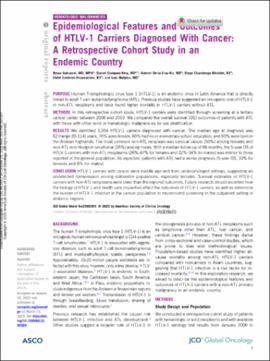
| dc.description.abstract | Purpose Human T-lymphotropic virus type 1 (HTLV-1) is an endemic virus in Latin America that is directly linked to adult T-cell leukemia/lymphoma (ATL). Previous studies have suggested an oncogenic role of HTLV-1 in non-ATL neoplasms and have found higher mortality in HTLV-1 carriers without ATL.Methods In this retrospective cohort study, HTLV-1 carriers were identified through screening at a tertiary cancer center between 2006 and 2019. We compared the overall survival (OS) outcomes of patients with ATL with those with other solid or hematologic malignancies by sex stratification.Results We identified 1,934 HTLV-1 carriers diagnosed with cancer. The median age at diagnosis was 62 (range 20-114) years, 76% were female, 60% had no or elementary school education, and 50% were born in the Andean highlands. The most common non-ATL neoplasm was cervical cancer (50%) among females and non-ATL non-Hodgkin lymphoma (26%) among males. With a median follow-up of 66 months, the 5-year OS of HTLV-1 carriers with non-ATL neoplasms (26%-47% for females and 22%-34% for males) was inferior to those reported in the general population. As expected, patients with ATL had a worse prognosis (5-year OS: 10% for females and 8% for males).Conclusion HTLV-1 carriers with cancer were middle age and from underprivileged settings, suggesting an undetected transmission among vulnerable populations, especially females. Survival estimates of HTLV-1 carriers with non-ATL neoplasms were lower than the regional outcomes. Future research should ascertain how the biology of HTLV-1 and health care disparities affect the outcomes of HTLV-1 carriers, as well as determine the burden of HTLV-1 infection in the cancer population to recommend screening in the outpatient setting of endemic regions. | en_US |
| dc.description.sponsorship | The authors would like to thank the administrative staff of the National Institute of Neoplastic Diseases for their support in developing this study. The authors thank the Lymphoma Scientific Research Mentoring Program of the Lymphoma Research Foundation for their support developing this study. | |
| dc.format | application/pdf | |
| dc.language.iso | eng | |
| dc.publisher | Lippincott Williams and Wilkins | |
| dc.relation.ispartof | urn:issn:2687-8941 | |
| dc.rights | https://purl.org/coar/access_right/c_abf2 | |
| dc.rights.uri | https://creativecommons.org/licenses/by-nc-sa/4.0/ | |
| dc.subject | SDG 3 | en_US |
| dc.subject | SDG 10 | en_US |
| dc.subject | Regulatory T Cells and Immune Response Dynamics | en_US |
| dc.subject | Adult T-Cell Leukemia/Lymphoma Dynamics | en_US |
| dc.title | Epidemiological Features and Outcomes of HTLV-1 Carriers Diagnosed with Cancer: A Retrospective Cohort Study in an Endemic Country | en_US |
| dc.type | https://purl.org/coar/resource_type/c_2df8fbb1 | |
| dc.identifier.doi | https://doi.org/10.1200/GO.22.00369 | |
| dc.subject.ocde | https://purl.org/pe-repo/ocde/ford#3.02.21 | |
| dc.type.other | Research article | |
| dc.identifier.journal | JCO Global Oncology | |
| dc.type.version | https://purl.org/coar/version/c_970fb48d4fbd8a85 |
Files in this item
This item appears in the following Collection(s)
-
Artículos de Investigación [1294]

Except where otherwise noted, this item's license is described as https://purl.org/coar/access_right/c_abf2