Bienestar mental, sentido de coherencia y factores sociodemográficos en médicos residentes de medicina familiar
| dc.contributor.author | Castro-Rodríguez, Y. | |
| dc.date.accessioned | 2025-10-31T18:35:21Z | |
| dc.date.available | 2025-10-31T18:35:21Z | |
| dc.date.issued | 2023 | |
| dc.identifier.uri | https://hdl.handle.net/20.500.12805/5273 | |
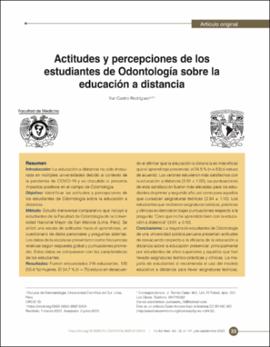
| dc.description.abstract | Introduction: Distance education has been instituted in multiple universities due to the context of the COVID-19 pandemic and it is debated whether it presents positive impacts in the field of Dentistry. Objective: To identify the attitudes and perceptions of dental students about distance education. Method: Cross-sectional comparative study that included students of the Faculty of Dentistry at the Universidad Nacional Mayor de San Marcos (Lima, Peru). A scale of attitudes toward learning, a personal data question-naire, and open questions was used. The scale data were presented as relative frequencies according to global response and average scores. These data were compared with the characteristics of the students. Results: 216 students were surveyed, and 120 (55.6 %) were female. 34.7% (n = 75) disagreed that distance education is more effective than face-to-face learning, and 24.5% (n = 53) agreed. Males were more satisfied with distance education (3.91 ± 1.02); scores for this satisfaction were higher for first and second-year students as well as for those taking theoretical subjects (3.94 ± 1.12). Students who received theoretical, practical, and clinical subjects evidenced low scores concerning the question “I think I have not learned well with distance education” (3.01 ± 0.12). Conclusions: The majority of dental students at a Peru-vian public university present attitude of disagreement regarding the effectiveness of distance education over face-to-face education, mainly by students in higher years and those who have taken theoretical-practical and clinical subjects. The majority of students do recommend the use of the distance education model to take theoretical subjects that do not require practical sessions where psychomotor skills are developed and where one subject per day is taken. | en_US |
| dc.format | application/pdf | |
| dc.language.iso | spa | |
| dc.publisher | Universidad Nacional Autónoma de Mexico | |
| dc.relation.ispartof | urn:issn:2007-5057 | |
| dc.rights | https://purl.org/coar/access_right/c_abf2 | |
| dc.rights.uri | https://creativecommons.org/licenses/by-nc-sa/4.0/ | |
| dc.subject | SDG 4 | en_US |
| dc.subject | COVID-19, Its Impact, and Vaccination | en_US |
| dc.subject | Challenges in Dental Education During COVID-19 | en_US |
| dc.title | Bienestar mental, sentido de coherencia y factores sociodemográficos en médicos residentes de medicina familiar | es_PE |
| dc.type | https://purl.org/coar/resource_type/c_2df8fbb1 | |
| dc.identifier.doi | https://doi.org/10.22201/fm.20075057e.2023.47.23513 | |
| dc.subject.ocde | https://purl.org/pe-repo/ocde/ford#3.02.24 | |
| dc.type.other | Research article | |
| dc.identifier.journal | Investigacion en Educacion Medica | |
| dc.type.version | https://purl.org/coar/version/c_970fb48d4fbd8a85 |
Files in this item
This item appears in the following Collection(s)
-
Artículos de Investigación [1294]

Except where otherwise noted, this item's license is described as https://purl.org/coar/access_right/c_abf2