Changing Mathematical Paradigms at the University Level: Feedback from a Flipped Classroom at a Peruvian University
| dc.contributor.author | Beltozar-Clemente, S. | |
| dc.contributor.author | Iparraguirre-Villanueva, O. | |
| dc.contributor.author | Zapata-Paulini, J. | |
| dc.contributor.author | Cabanillas-Carbonell, M. | |
| dc.date.accessioned | 2025-10-31T18:35:02Z | |
| dc.date.available | 2025-10-31T18:35:02Z | |
| dc.date.issued | 2023 | |
| dc.identifier.uri | https://hdl.handle.net/20.500.12805/5225 | |
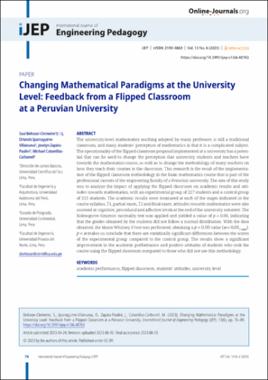
| dc.description.abstract | The university-level mathematics teaching adopted by many professors is still a traditional classroom, and many students’ perception of mathematics is that it is a complicated subject. The operationality of the flipped classroom proposal implemented at a university has a potential that can be used to change the perception that university students and teachers have towards the mathematics course, as well as to change the methodology of many teachers on how they teach their courses in the classroom. This research is the result of the implementation of the flipped classroom methodology in the basic mathematics course that is part of the professional careers of the engineering faculty of a Peruvian university. The aim of this study was to analyze the impact of applying the flipped classroom on academic results and attitudes towards mathematics, with an experimental group of 227 students and a control group of 215 students. The academic results were measured at each of the stages indicated in the course syllabus, T1, partial exam, T2 and final exam; attitudes towards mathematics were also assessed at cognitive, procedural and affective levels at the end of the university semester. The Kolmogorov-Smirnov normality test was applied and yielded a value of p = 0.00, indicating that the grades obtained by the students did not follow a normal distribution. With the data obtained, the Mann-Whitney U test was performed, obtaining a p = 0.00 value (α = 0,05<inf>2 tails</inf>). p < α makes us conclude that there are statistically significant differences between the scores of the experimental group compared to the control group. The results show a significant improvement in the academic performance and positive attitudes of students who took the course using the flipped classroom compared to those who did not use this methodology. | en_US |
| dc.format | application/pdf | |
| dc.language.iso | eng | |
| dc.publisher | International Association of Online Engineering | |
| dc.relation.ispartof | urn:issn:2192-4880 | |
| dc.rights | https://purl.org/coar/access_right/c_abf2 | |
| dc.rights.uri | https://creativecommons.org/licenses/by-nc-sa/4.0/ | |
| dc.subject | Innovative Approaches in Medical Education and Learning | en_US |
| dc.subject | Flipped Classroom Models in Higher Education | en_US |
| dc.title | Changing Mathematical Paradigms at the University Level: Feedback from a Flipped Classroom at a Peruvian University | en_US |
| dc.type | https://purl.org/coar/resource_type/c_2df8fbb1 | |
| dc.identifier.doi | https://doi.org/10.3991/ijep.v13i6.40763 | |
| dc.subject.ocde | https://purl.org/pe-repo/ocde/ford#5.03.01 | |
| dc.type.other | Research article | |
| dc.identifier.journal | International Journal of Engineering Pedagogy | |
| dc.type.version | https://purl.org/coar/version/c_970fb48d4fbd8a85 |
Files in this item
This item appears in the following Collection(s)
-
Artículos de Investigación [1294]

Except where otherwise noted, this item's license is described as https://purl.org/coar/access_right/c_abf2