Prevalencia de sintomatología depresiva en médicos internos de pregrado en una universidad privada en Puebla, México
| dc.contributor.author | García-Cadena, C.H. | |
| dc.contributor.author | Daniel-González, L. | |
| dc.contributor.author | García Martínez, F.E. | |
| dc.contributor.author | Caycho-Rodríguez, T. | |
| dc.contributor.author | Quiceno Sierra, Y.J.M. | |
| dc.date.accessioned | 2025-10-31T18:34:55Z | |
| dc.date.available | 2025-10-31T18:34:55Z | |
| dc.date.issued | 2023 | |
| dc.identifier.uri | https://hdl.handle.net/20.500.12805/5208 | |
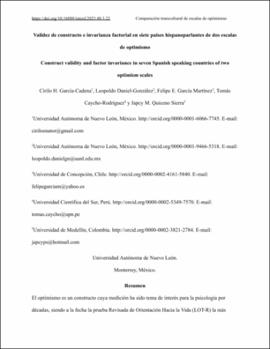
| dc.description.abstract | Optimism is a construct which its measurement has been relevant for psychology since several decades ago. Today there are two main theories about optimism, from which have been designed instruments for measuring it such Likert-scales. The first approach is the theory of the positive expectancies, which this type of personality approach originated the most famous American scale for measure optimism, the Life Orientation Test-Revised (LOT-R), and the German Scale of Personal Optimism (SPO). The second approach is the interactive style of personality, which has given rise to the Mexican Brief Interactive Optimism Scale-Garcia (BIOS-G). According to the positive expectations theory, optimism could be seen as a psychological disposition in the person which thinks that will have favorable and good outcomes in the future, that the person believe will get benefits in the time to come. It is a generalized belief which would occur independently of the context and of the specific conditions where the behavior happens. On the other hand, the theory of the interactive style of personality states that in terms of the life lived by the person and his/her present circumstances, thinks that life has been worth living, that is good to live more, and that generally the world and people are good, that is reasonable to expect good results interacting with them. And here is conceptualized the optimism also as a psychological disposition. However, there is no studies that measure this construct from different perspectives comparing distinct countries. The primary objective of this study was to compare in construct validity and reliability the Life Orientation Test-Revised (LOT-R) and the Brief Interactive Optimism Scale-Garcia (BIOS-G) in seven Hispanic speaking countries like Mexico, Colombia, Spain, Perú, Bolivia, Ecuador, and Chile. The second objective was to find the factor invariance of both scales in the seven above mentioned countries. It was used a convenience sample (1 712 Spanish-speaking people; 629 men, 1083 women), formed by 989 participants from general population (México, Chile, Ecuador, and Bolivia), 481 college students (Perú = 220, and Spain = 261), and 242 high school students (Colombia). Mage = 30.74 years (SD = 11.371). About the perceived socioeconomic level, it was found that participants considered themselves as the following: 4.50 % (77) from Low-Low to Low-High, 86.50 % (1481) from Middle-Low to Middle-High, and 9 % (154) from High-Low to High-High. In terms of schooling, the sample was composed as following: Elementary school.30 % (5), Junior high school 8.40 % (143), High school 10.10 % (173), College 60.20 % (1030), Graduate school 21.10 % (361). To evaluate the factor structure, it was used one group confirmatory factor analysis (CFA), and to test factorial invariance between countries it was used multigroup analysis. Discrepancy function was optimized using the maximum likelihood method. In multigroup analysis, it was defined nested models with constraints. Eight indices were used in both multigroup and one group analysis to find goodness of fit: Chi square ratio (χ2/df), Goodness of fit index (GFI) and its adjusted formula (AGFI), Normed fit index (NFI), Non normed fit index (NNFI), Comparative fit index (CFI), Standardized root mean square residual (SRMR), and Root mean square error of approximation (RMSEA). Although LOT-R presents appropriate goodness of fit in two countries, BIOS-G beats it. BIOS-G gets good ω values in the seven countries, and LOT-R in two only. BIOS-G shows better factor invariance. BIOS-G obtains acceptable and excellent values in H coefficient in the seven countries, but LOT-R in four only. Correlation between BIOS-G and LOT-R is significant, r =.45, p <.01, (CI 95%, .41, .49; d = small). Tentative conclusion: Probably the BIOS-G it is a good option to measure optimism in Spanish speaking people. | en_US |
| dc.format | application/pdf | |
| dc.language.iso | eng | |
| dc.language.iso | spa | |
| dc.publisher | Centro Interamericano de Investigaciones Psicológicas y Ciencias Afines | |
| dc.relation.ispartof | urn:issn:1668-7027 | |
| dc.rights | https://purl.org/coar/access_right/c_abf2 | |
| dc.rights.uri | https://creativecommons.org/licenses/by-nc-sa/4.0/ | |
| dc.subject | Emotional Wellbeing and Life Satisfaction Insights | en_US |
| dc.subject | Optimism and Pessimism in Health Outcomes | en_US |
| dc.title | Prevalencia de sintomatología depresiva en médicos internos de pregrado en una universidad privada en Puebla, México | es_PE |
| dc.title.alternative | Construct validity and factor invariance in seven Spanish speaking countries of two optimism scales | en_US |
| dc.type | https://purl.org/coar/resource_type/c_2df8fbb1 | |
| dc.identifier.doi | https://doi.org/10.16888/interd.2023.40.3.22 | |
| dc.subject.ocde | https://purl.org/pe-repo/ocde/ford#5.01.01 | |
| dc.type.other | Research article | |
| dc.identifier.journal | Interdisciplinaria | |
| dc.type.version | https://purl.org/coar/version/c_970fb48d4fbd8a85 |
Files in this item
This item appears in the following Collection(s)
-
Artículos de Investigación [1294]

Except where otherwise noted, this item's license is described as https://purl.org/coar/access_right/c_abf2