Antibiotic prophylaxis compliance differences in surgery and gynecology/obstetrics services in Huánuco, Peru
| dc.contributor.author | Panduro-Correa, V. | |
| dc.contributor.author | Gomez-Gonzales, W. | |
| dc.contributor.author | Rabaan, A.A. | |
| dc.contributor.author | Valencia-Martínez, J.C. | |
| dc.contributor.author | Gutiérrez-Acuña, Y. | |
| dc.contributor.author | Chihuantito-Abal, L. | |
| dc.contributor.author | Zavaleta-Oliver, J. | |
| dc.contributor.author | Barboza, J.J. | |
| dc.contributor.author | Rodriguez-Morales, A.J. | |
| dc.contributor.author | Arteaga-Livias, K. | |
| dc.date.accessioned | 2025-10-31T18:34:53Z | |
| dc.date.available | 2025-10-31T18:34:53Z | |
| dc.date.issued | 2023 | |
| dc.identifier.uri | https://infezmed.it/media/articoli-html/Vol_31_3_2023_10.html | |
| dc.identifier.uri | https://hdl.handle.net/20.500.12805/5202 | |
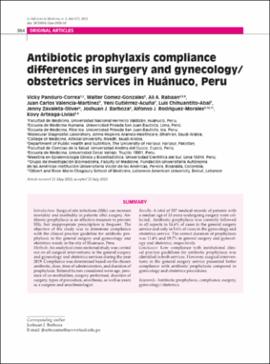
| dc.description.abstract | Introduction: Surgical site infections (SSIs) can increase mortality and morbidity in patients after surgery. Antibiotic prophylaxis is an effective measure to prevent SSIs, but inappropriate prescription is frequent. The objective of the study was to determine compliance with the clinical practice guideline for antibiotic prophylaxis in the general surgery and gynecology and obstetrics wards in the city of Huánuco, Peru. Methods: An analytical cross-sectional study was carried out on all surgical interventions in the general surgery and gynecology and obstetrics services during the year 2019. Compliance was determined based on the chosen antibiotic, dose, time of administration, and duration of prophylaxis. Related factors considered were age, presence of co-morbidities, surgery performed, duration of surgery, types of procedure, anesthesia, as well as years as a surgeon and anesthesiologist. Results: A total of 557 medical records of patients with a median age of 33 years undergoing surgery were collected,. Antibiotic prophylaxis was correctly followed in all aspects in 14.6% of cases in the general surgery service and only in 5.6% of cases in the gynecology and obstetrics service. The correct duration of prophylaxis was 11.6% and 19.7% in general surgery and gynecol-ogy and obstetrics, respectively. Conclusion: Low compliance with institutional clinical practice guidelines for antibiotic prophylaxis was identified in both services. However, surgical interventions in the general surgery service presented better compliance with antibiotic prophylaxis compared to gynecology and obstetrics procedures. | en_US |
| dc.format | application/pdf | |
| dc.language.iso | eng | |
| dc.publisher | EDIMES Edizioni Médico Scientifiche | |
| dc.relation.ispartof | urn:issn:1124-9390 | |
| dc.rights | https://purl.org/coar/access_right/c_abf2 | |
| dc.rights.uri | https://creativecommons.org/licenses/by-nc-sa/4.0/ | |
| dc.subject | Surgical Outcomes and Treatment Strategies for Uterine Conditions | en_US |
| dc.subject | Optimizing Prophylactic Antibiotic Use in Surgery | en_US |
| dc.title | Antibiotic prophylaxis compliance differences in surgery and gynecology/obstetrics services in Huánuco, Peru | en_US |
| dc.type | https://purl.org/coar/resource_type/c_2df8fbb1 | |
| dc.subject.ocde | https://purl.org/pe-repo/ocde/ford#3.02.11 | |
| dc.type.other | Research article | |
| dc.identifier.journal | Infezioni in Medicina | |
| dc.type.version | https://purl.org/coar/version/c_970fb48d4fbd8a85 |
Files in this item
This item appears in the following Collection(s)
-
Artículos de Investigación [1294]

Except where otherwise noted, this item's license is described as https://purl.org/coar/access_right/c_abf2