Carbon accrual rates, vegetation and nutrient dynamics in a regularly burned coppice woodland in Germany
| dc.contributor.author | Borchard, N. | |
| dc.contributor.author | Adolphs, T. | |
| dc.contributor.author | Beulshausen, F. | |
| dc.contributor.author | Ladd, B. | |
| dc.contributor.author | Gießelmann, U.C. | |
| dc.contributor.author | Hegenberg, D. | |
| dc.contributor.author | Möseler, B.M. | |
| dc.contributor.author | Amelung, W. | |
| dc.date.accessioned | 2025-10-31T18:34:31Z | |
| dc.date.available | 2025-10-31T18:34:31Z | |
| dc.date.issued | 2017 | |
| dc.identifier.uri | https://hdl.handle.net/20.500.12805/5143 | |
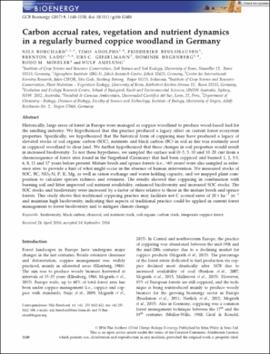
| dc.description.abstract | Historically, large areas of forest in Europe were managed as coppice woodland to produce wood-based fuel for the smelting industry. We hypothesized that this practice produced a legacy effect on current forest ecosystem properties. Specifically, we hypothesized that the historical form of coppicing may have produced a legacy of elevated stocks of soil organic carbon (SOC), nutrients and black carbon (BC) in soil as fire was routinely used in coppiced woodland to clear land. We further hypothesized that these changes in soil properties would result in increased biodiversity. To test these hypotheses, we sampled the surface soil (0–5, 5–10 and 10–20 cm) from a chronosequence of forest sites found in the Siegerland (Germany) that had been coppiced and burned 1, 2, 3.5, 6, 8, 11 and 17 years before present. Mature beech and spruce forests (i.e., >60 years) were also sampled as reference sites: to provide a hint of what might occur in the absence of human intervention. We measured stocks of SOC, BC, NO<inf>3</inf>-N, P, K, Mg, as well as cation exchange and water-holding capacity, and we mapped plant composition to calculate species richness and evenness. The results showed that coppicing in combination with burning soil and litter improved soil nutrient availability, enhanced biodiversity and increased SOC stocks. The SOC stocks and biodiversity were increased by a factor of three relative to those in the mature beech and spruce forests. This study shows that traditional coppicing practice may facilitate net C accrual rates of 20 t ha−1 yr−1 and maintain high biodiversity, indicating that aspects of traditional practice could be applied in current forest management to foster biodiversity and to mitigate climate change. | en_US |
| dc.format | application/pdf | |
| dc.language.iso | eng | |
| dc.publisher | Blackwell Publishing | |
| dc.relation.ispartof | urn:issn:1757-1707 | |
| dc.rights | https://purl.org/coar/access_right/c_abf2 | |
| dc.rights.uri | https://creativecommons.org/licenses/by-nc-sa/4.0/ | |
| dc.subject | SDG 7 | en_US |
| dc.subject | SDG 12 | en_US |
| dc.subject | SDG 13 | en_US |
| dc.subject | SDG 15 | en_US |
| dc.subject | Interactions of Soil, Water, and Forest Dynamics | en_US |
| dc.subject | Water Dynamics in Forest Canopy Systems | en_US |
| dc.title | Carbon accrual rates, vegetation and nutrient dynamics in a regularly burned coppice woodland in Germany | en_US |
| dc.type | https://purl.org/coar/resource_type/c_2df8fbb1 | |
| dc.identifier.doi | https://doi.org/10.1111/gcbb.12408 | |
| dc.subject.ocde | https://purl.org/pe-repo/ocde/ford#1.05.10 | |
| dc.type.other | Research article | |
| dc.identifier.journal | GCB Bioenergy | |
| dc.type.version | https://purl.org/coar/version/c_970fb48d4fbd8a85 |
Files in this item
This item appears in the following Collection(s)
-
Artículos de Investigación [1294]

Except where otherwise noted, this item's license is described as https://purl.org/coar/access_right/c_abf2