Psychometric properties and invariance of an English self-efficacy scale for university students in Peru
| dc.contributor.author | Mendoza-Torres, M.E. | |
| dc.contributor.author | Morales-García, W.C. | |
| dc.contributor.author | Sairitupa-Sanchez, L.Z. | |
| dc.contributor.author | Morales-García, S.B. | |
| dc.contributor.author | Rivera-Lozada, O. | |
| dc.contributor.author | Sucapuca-Sucapuca, F.E. | |
| dc.contributor.author | Cunza-Aranzábal, D.F. | |
| dc.date.accessioned | 2025-10-31T18:34:26Z | |
| dc.date.available | 2025-10-31T18:34:26Z | |
| dc.date.issued | 2023 | |
| dc.identifier.uri | https://hdl.handle.net/20.500.12805/5129 | |
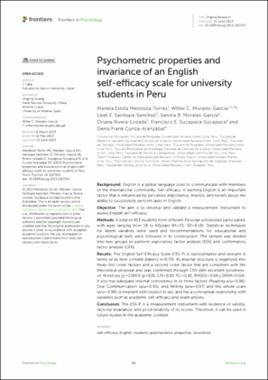
| dc.description.abstract | Background: English is a global language used to communicate with members of the international community. Self-efficacy in learning English is an important factor that is influenced by perceived importance, interest, and beliefs about the ability to successfully perform tasks in English. Objective: The aim is to develop and validate a measurement instrument to assess English self-efficacy. Methods: A total of 453 students from different Peruvian universities participated, with ages ranging from 18 to 60 years (M = 23; SD = 6.18). Statistical techniques for latent variables were used and recommendations for educational and psychological tests were followed in its construction. The sample was divided into two groups to perform exploratory factor analysis (EFA) and confirmatory factor analysis (CFA). Results: The English Self-Efficacy Scale (ESS-P) is representative and relevant in terms of its item content (Aiken’s V > 0.70). Its internal structure is organized into three first order factors and a second order factor that are consistent with the theoretical proposal and was confirmed through CFA with excellent goodness-of-fit indices (χ2 = 1184.9, gl = 626, CFI = 0.92, TLI = 0.92, RMSEA = 0.06 y SRMR = 0.04). It also has adequate internal consistency in its three factors (Reading α/ω = 0.96), Oral Communication (α/ω = 0.95), and Writing (α/ω = 0.97) and the whole scale (α/ω = 0.98), is invariant with respect to sex, and has a conceptual relationship with variables such as academic self-efficacy and exam anxiety. Conclusion: The ESS-P is a measurement instrument with evidence of validity, factorial invariance, and good reliability of its scores. Therefore, it can be used in future studies in the academic context. | en_US |
| dc.format | application/pdf | |
| dc.language.iso | eng | |
| dc.publisher | Frontiers Media | |
| dc.relation.ispartof | urn:issn:1664-1078 | |
| dc.rights | https://purl.org/coar/access_right/c_abf2 | |
| dc.rights.uri | https://creativecommons.org/licenses/by-nc-sa/4.0/ | |
| dc.subject | Self-Efficacy and Academic Performance in Education | en_US |
| dc.subject | Teacher Self Efficacy and Student Learning Outcomes | en_US |
| dc.title | Psychometric properties and invariance of an English self-efficacy scale for university students in Peru | en_US |
| dc.type | https://purl.org/coar/resource_type/c_2df8fbb1 | |
| dc.identifier.doi | https://doi.org/10.3389/fpsyg.2023.1187342 | |
| dc.subject.ocde | https://purl.org/pe-repo/ocde/ford#5.01.01 | |
| dc.type.other | Research article | |
| dc.identifier.journal | Frontiers in Psychology | |
| dc.type.version | https://purl.org/coar/version/c_970fb48d4fbd8a85 |
Files in this item
This item appears in the following Collection(s)
-
Artículos de Investigación [1294]

Except where otherwise noted, this item's license is described as https://purl.org/coar/access_right/c_abf2