Association between weight status and migraine in the paediatric population: a systematic review and meta-analysis
| dc.contributor.author | Quispe-Vicuña, C. | |
| dc.contributor.author | Soriano-Moreno, D.R. | |
| dc.contributor.author | De-Los-Rios-Pinto, A. | |
| dc.contributor.author | Díaz-Ledesma, L.A. | |
| dc.contributor.author | Fernandez-Guzman, D. | |
| dc.contributor.author | Pacheco-Barrios, K. | |
| dc.contributor.author | Alva-Diaz, C. | |
| dc.date.accessioned | 2025-10-31T18:34:21Z | |
| dc.date.available | 2025-10-31T18:34:21Z | |
| dc.date.issued | 2023 | |
| dc.identifier.uri | https://hdl.handle.net/20.500.12805/5115 | |
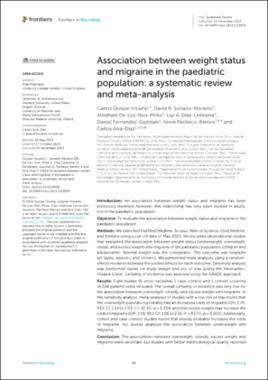
| dc.description.abstract | Introduction: An association between weight status and migraine has been previously reported; however, this relationship has only been studied in adults, not in the paediatric population. Objective: To evaluate the association between weight status and migraine in the paediatric population. Methods: We searched PubMed/Medline, Scopus, Web of Science, Ovid Medline, and Embase using a cut-off date of May 2023. We included observational studies that evaluated the association between weight status (underweight, overweight, obese, and excess weight) and migraine in the paediatric population (children and adolescents). Normal weight was the comparator. The outcome was migraine (all types, episodic and chronic). We performed meta-analyses using a random-effects model to estimate the pooled effects for each outcome. Sensitivity analysis was performed based on study design and risk of bias (using the Newcastle–Ottawa Scale). Certainty of evidence was assessed using the GRADE approach. Results: Eight studies (6 cross-sectional, 1 case-control and 1 cohort) covering 16,556 patients were included. The overall certainty of evidence was very low for the association between overweight, obesity, and excess weight with migraine. In the sensitivity analysis, meta-analyses of studies with a low risk of bias found that the overweight population probably had an increased odds of migraine (OR: 1.70; 95% CI: 1.14 to 2.53; I2 = 32.3%, p = 0.224) and that excess weight may increase the odds of migraine (OR: 1.58; 95% CI: 1.06 to 2.35; I2 = 83.7%, p = 0.002). Additionally, cohort and case-control studies found that obesity probably increases the odds of migraine. No studies analysed the association between underweight and migraine. Conclusion: The associations between overweight, obesity, excess weight and migraine were uncertain, but studies with better methodological quality reported increased odds. Future longitudinal studies with proper confounding control are needed to disentangle their causal relationship. Systematic review registration: PROSPERO, identifier CRD42021271533. | en_US |
| dc.format | application/pdf | |
| dc.language.iso | eng | |
| dc.publisher | Frontiers Media | |
| dc.relation.ispartof | urn:issn:1664-2295 | |
| dc.rights | https://purl.org/coar/access_right/c_abf2 | |
| dc.rights.uri | https://creativecommons.org/licenses/by-nc-sa/4.0/ | |
| dc.subject | SDG 3 | en_US |
| dc.subject | CGRP Pathways and Migraine Management Insights | en_US |
| dc.subject | Migraine Associations with Obesity and Dietary Factors | en_US |
| dc.title | Association between weight status and migraine in the paediatric population: a systematic review and meta-analysis | en_US |
| dc.type | https://purl.org/coar/resource_type/c_2df8fbb1 | |
| dc.identifier.doi | https://doi.org/10.3389/fneur.2023.1225935 | |
| dc.subject.ocde | https://purl.org/pe-repo/ocde/ford#3.02.03 | |
| dc.type.other | Research article | |
| dc.identifier.journal | Frontiers in Neurology | |
| dc.type.version | https://purl.org/coar/version/c_970fb48d4fbd8a85 |
Files in this item
This item appears in the following Collection(s)
-
Artículos de Investigación [1294]

Except where otherwise noted, this item's license is described as https://purl.org/coar/access_right/c_abf2