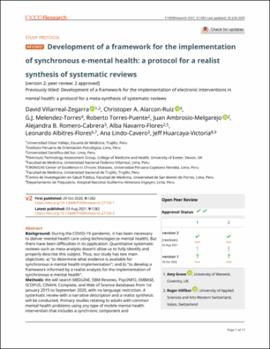
Development of a framework for the implementation of synchronous e-mental health: A protocol for a realist synthesis of systematic reviews
| dc.contributor.author | Alarcon-Ruiz, C.A. | |
| dc.contributor.author | Villarreal-Zegarra, D. | |
| dc.contributor.author | Melendez-Torres, G.J. | |
| dc.contributor.author | Torres-Puente, R. | |
| dc.contributor.author | Ambrosio-Melgarejo, J. | |
| dc.contributor.author | Romero-Cabrera, A.B. | |
| dc.contributor.author | Navarro-Flores, A. | |
| dc.contributor.author | Albitres-Flores, L. | |
| dc.contributor.author | Lindo-Cavero, A. | |
| dc.contributor.author | Huarcaya-Victoria, J. | |
| dc.date.accessioned | 2025-10-31T18:34:08Z | |
| dc.date.available | 2025-10-31T18:34:08Z | |
| dc.date.issued | 2021 | |
| dc.identifier.uri | https://hdl.handle.net/20.500.12805/5079 | |
| dc.description.abstract | Background: During the COVID-19 pandemic, it has been necessary to deliver mental health care using technologies (e-mental health). But there have been difficulties in its application. Quantitative systematic reviews such as meta-analysis doesn't allow us to fully identify and properly describe this subject. Thus, our study has two main objectives: a) "to determine what evidence is available for synchronous e-mental health implementation"; and b) "to develop a framework informed by a realist analysis for the implementation of synchronous e-mental health". Methods: We will search MEDLINE, EBM Reviews, PsycINFO, EMBASE, SCOPUS, CINAHL Complete, and Web of Science databases from 1st January 2015 to September 2020, with no language restriction. A systematic review with a narrative description and a realist synthesis will be conducted. Primary studies relating to adults with common mental health problems using any type of mobile mental health intervention that includes a synchronic component and communication with a mental health professional will be included. For the analysis, we will make a realist synthesis of the systematic reviews, using a grounded theory approach with an emergent approach to synthesize the information, prioritizing the systematic reviews with a lower risk of bias in the AMSTAR-2 tool. The realist synthesis will be based on the interpretation, integration, and inference of the evaluated elements and the generation of hypotheses to better understand the implementation process of synchronous e-mental health. Finally, we will present the overall assessment in a Summary of Qualitative Findings table. Conclusion: Our results will allow a better understanding of the facilitator and limitations in implementing e-mental health. | en_US |
| dc.description.sponsorship | The authors acknowledge Jackeline Garcia and Juan Barrera, for helping with the initial phases of the information search. | |
| dc.format | application/pdf | |
| dc.language.iso | eng | |
| dc.publisher | Research | |
| dc.relation.ispartof | urn:issn:2046-1402 | |
| dc.rights | https://purl.org/coar/access_right/c_abf2 | |
| dc.rights.uri | https://creativecommons.org/licenses/by-nc-sa/4.0/ | |
| dc.subject | Mental Health Impacts of COVID-19 Pandemic | en_US |
| dc.subject | Mobile Technology in Mental Health Interventions | en_US |
| dc.title | Development of a framework for the implementation of synchronous e-mental health: A protocol for a realist synthesis of systematic reviews | en_US |
| dc.type | https://purl.org/coar/resource_type/c_2df8fbb1 | |
| dc.identifier.doi | https://doi.org/10.12688/f1000research.27150.2 | |
| dc.subject.ocde | https://purl.org/pe-repo/ocde/ford#3.03.01 | |
| dc.type.other | Research article | |
| dc.identifier.journal | F1000Research | |
| dc.type.version | https://purl.org/coar/version/c_970fb48d4fbd8a85 |
Files in this item
This item appears in the following Collection(s)
-
Artículos de Investigación [1294]

Except where otherwise noted, this item's license is described as https://purl.org/coar/access_right/c_abf2