Risk factors for mortality in hospitalized patients with COVID-19 from three hospitals in Peru: A retrospective cohort study
| dc.contributor.author | Urrunaga-Pastor, D. | |
| dc.contributor.author | Díaz-Vélez, C. | |
| dc.contributor.author | Romero-Cerdán, A. | |
| dc.contributor.author | Peña-Sánchez, E.R. | |
| dc.contributor.author | Fernández Mogollon, J.L. | |
| dc.contributor.author | Cossio Chafloque, J.D. | |
| dc.contributor.author | Marreros Ascoy, G.C. | |
| dc.contributor.author | Benites-Zapata, V.A. | |
| dc.date.accessioned | 2025-10-31T18:34:07Z | |
| dc.date.available | 2025-10-31T18:34:07Z | |
| dc.date.issued | 2021 | |
| dc.identifier.uri | https://hdl.handle.net/20.500.12805/5075 | |
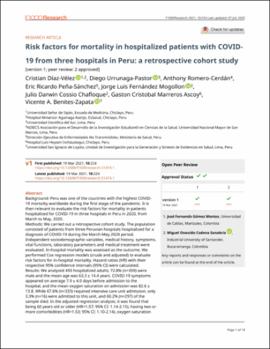
| dc.description.abstract | Background: Peru was one of the countries with the highest COVID-19 mortality worldwide during the first stage of the pandemic. It is then relevant to evaluate the risk factors for mortality in patients hospitalized for COVID-19 in three hospitals in Peru in 2020, from March to May, 2020. Methods: We carried out a retrospective cohort study. The population consisted of patients from three Peruvian hospitals hospitalized for a diagnosis of COVID-19 during the March-May 2020 period. Independent sociodemographic variables, medical history, symptoms, vital functions, laboratory parameters and medical treatment were evaluated. In-hospital mortality was assessed as the outcome. We performed Cox regression models (crude and adjusted) to evaluate risk factors for in-hospital mortality. Hazard ratios (HR) with their respective 95% confidence intervals (95% CI) were calculated. Results: We analyzed 493 hospitalized adults; 72.8% (n=359) were male and the mean age was 63.3 ± 14.4 years. COVID-19 symptoms appeared on average 7.9 ± 4.0 days before admission to the hospital, and the mean oxygen saturation on admission was 82.6 ± 13.8. While 67.6% (n=333) required intensive care unit admission, only 3.3% (n=16) were admitted to this unit, and 60.2% (n=297) of the sample died. In the adjusted regression analysis, it was found that being 60 years old or older (HR=1.57; 95% CI: 1.14-2.15), having two or more comorbidities (HR=1.53; 95% CI: 1.10-2.14), oxygen saturation between 85-80% (HR=2.52; 95% CI: 1.58-4.02), less than 80% (HR=4.59; 95% CI: 3.01-7.00), and being in the middle (HR=1.65; 95% CI: 1.15-2.39) and higher tertile (HR=2.18; 95% CI: 1.51-3.15) of the neutrophil-to-lymphocyte ratio, increased the risk of mortality. Conclusions: The risk factors found agree with what has been described in the literature and allow the identification of vulnerable groups in whom monitoring and early identification of symptoms should be prioritized in order to reduce mortality. | en_US |
| dc.format | application/pdf | |
| dc.language.iso | eng | |
| dc.publisher | F1000 Research | |
| dc.relation.ispartof | urn:issn:2046-1402 | |
| dc.rights | https://purl.org/coar/access_right/c_abf2 | |
| dc.rights.uri | https://creativecommons.org/licenses/by-nc-sa/4.0/ | |
| dc.subject | SDG 3 | en_US |
| dc.subject | COVID-19, Its Impact, and Vaccination | en_US |
| dc.subject | Prognostic Value of Inflammatory Ratios in COVID-19 | en_US |
| dc.title | Risk factors for mortality in hospitalized patients with COVID-19 from three hospitals in Peru: A retrospective cohort study | en_US |
| dc.type | https://purl.org/coar/resource_type/c_2df8fbb1 | |
| dc.identifier.doi | https://doi.org/10.12688/f1000research.51474.1 | |
| dc.subject.ocde | https://purl.org/pe-repo/ocde/ford#3.00.00 | |
| dc.type.other | Research article | |
| dc.identifier.journal | F1000Research | |
| dc.type.version | https://purl.org/coar/version/c_970fb48d4fbd8a85 |
Files in this item
This item appears in the following Collection(s)
-
Artículos de Investigación [1294]

Except where otherwise noted, this item's license is described as https://purl.org/coar/access_right/c_abf2