Sociodemographic factors associated with immediate puerperal control: A cross-sectional study based on the Peruvian demographic and health survey, 2019
| dc.contributor.author | Díaz-Canales, A. | |
| dc.contributor.author | Noel-Meza, J.P. | |
| dc.contributor.author | Caira-Chuquineyra, B. | |
| dc.contributor.author | Fernandez-Guzman, D. | |
| dc.contributor.author | Salazar-Talla, L. | |
| dc.contributor.author | Urrunaga-Pastor, D. | |
| dc.contributor.author | Bendezu-Quispe, G. | |
| dc.date.accessioned | 2025-10-31T18:34:06Z | |
| dc.date.available | 2025-10-31T18:34:06Z | |
| dc.date.issued | 2023 | |
| dc.identifier.uri | https://hdl.handle.net/20.500.12805/5072 | |
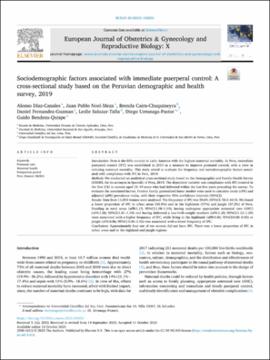
| dc.description.abstract | Introduction: Peru is the fifth country in Latin America with the highest maternal mortality. In Peru, immediate puerperal control (IPC) was established in 2013 as a measure to improve postnatal control, with a view in reducing maternal mortality. This study aimed to evaluate the frequency and sociodemographic factors associated with compliance with IPC in Peru, 2019. Methods: We conducted an analytical cross-sectional study based on the Demographic and Family Health Survey (ENDES, for its acronym in Spanish) of Peru, 2019. The dependent variable was compliance with IPC (control in the first 2 h) in women aged 15–49 years who had delivered within the last five years preceding the survey. To evaluate the associated factors, Poisson family generalized linear models were used to calculate crude (cPR) and adjusted (aPR) prevalence ratios, with their respective 95% confidence intervals (95%CI). Results: Data from 11,854 women were analyzed. The frequency of IPC was 59.6% (95%CI: 58.3–60.9). We found a lower proportion of IPC in urban areas (58.8%) and in the highlands (57%) and jungle (57.2%) of Peru. Residing in rural areas (aPR:1.13; 95%CI:1.08–1.19), having undergone appropriate antenatal care (ANC) (aPR:1.05; 95%CI:1.01–1.10) and having delivered a low-birth-weight newborn (aPR:1.20; 95%CI:1.12–1.29) were associated with a higher frequency of IPC, while living in the highlands (aPR:0.86; 95%CI:0.80–0.92) or jungle (aPR:0.86; 95%CI:0.80–0.92) was associated with a lower frequency of IPC. Conclusions: Approximately four out of ten women did not have IPC. There was a lower proportion of IPC in urban areas and in the highland and jungle regions. | en_US |
| dc.format | application/pdf | |
| dc.language.iso | eng | |
| dc.publisher | Elsevier Ireland | |
| dc.relation.ispartof | urn:issn:2590-1613 | |
| dc.rights | https://purl.org/coar/access_right/c_abf2 | |
| dc.rights.uri | https://creativecommons.org/licenses/by-nc-sa/4.0/ | |
| dc.subject | SDG 3 | en_US |
| dc.subject | Enhancing Maternal Health Services in Communities | en_US |
| dc.subject | Enhancing Maternal Health Services and Outcomes | en_US |
| dc.title | Sociodemographic factors associated with immediate puerperal control: A cross-sectional study based on the Peruvian demographic and health survey, 2019 | en_US |
| dc.type | https://purl.org/coar/resource_type/c_2df8fbb1 | |
| dc.identifier.doi | https://doi.org/10.1016/j.eurox.2023.100253 | |
| dc.subject.ocde | https://purl.org/pe-repo/ocde/ford#3.03.05 | |
| dc.type.other | Research article | |
| dc.identifier.journal | European Journal of Obstetrics and Gynecology and Reproductive Biology: X | |
| dc.type.version | https://purl.org/coar/version/c_970fb48d4fbd8a85 |
Files in this item
This item appears in the following Collection(s)
-
Artículos de Investigación [1294]

Except where otherwise noted, this item's license is described as https://purl.org/coar/access_right/c_abf2