Level of knowledge about metalloproteinases in dental students close to graduate from three universities in Peruvian capital city
| dc.contributor.author | Cayo-Rojas, C.F. | |
| dc.contributor.author | Soto-Castro, L. | |
| dc.contributor.author | Castro-Mena, M. | |
| dc.contributor.author | Medrano-Colmenares, S. | |
| dc.contributor.author | López-Gurreonero, C. | |
| dc.contributor.author | Córdova-Limaylla, N. | |
| dc.contributor.author | Briceño-Vergel, G. | |
| dc.contributor.author | Ladera-Castañeda, M. | |
| dc.contributor.author | Cervantes-Ganoza, L. | |
| dc.date.accessioned | 2025-10-31T18:34:06Z | |
| dc.date.available | 2025-10-31T18:34:06Z | |
| dc.date.issued | 2022 | |
| dc.identifier.uri | https://hdl.handle.net/20.500.12805/5071 | |
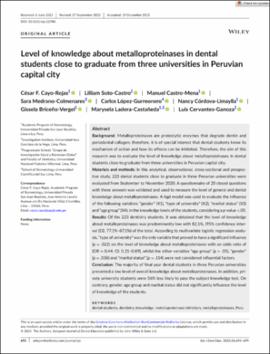
| dc.description.abstract | Background: Metalloproteinases are proteolytic enzymes that degrade dentin and periodontal collagen; therefore, it is of special interest that dental students know its mechanism of action and how its effects can be inhibited. Therefore, the aim of this research was to evaluate the level of knowledge about metalloproteinases in dental students close to graduate from three universities in Peruvian capital city. Materials and methods: In this analytical, observational, cross-sectional and prospective study, 223 dental students close to graduate in three Peruvian universities were evaluated from September to November 2020. A questionnaire of 20 closed questions with three answers was validated and used to measure the level of general and dental knowledge about metalloproteinases. A logit model was used to evaluate the influence of the following variables: “gender” (X1), “type of university” (X2), “marital status” (X3) and “age group” (X4), in the knowledge levels of the students, considering a p-value <.05. Results: Of the 223 dentistry students, it was obtained that the level of knowledge about metalloproteinases was predominantly low with 82.1%, (95% confidence interval (CI): 77.1%–87.1%) of the total. According to multivariate logistic regression analysis, "type of university" was the only variable that proved to have a significant influence (p =.022) on the level of knowledge about metalloproteinases with an odds ratio of (OR = 0.44; CI: 0.21–0.89), whilst the other variables "age group" (p >.05), "gender" (p =.058) and "marital status" (p =.114) were not considered influential factors. Conclusion: The majority of final year dental students in three Peruvian universities presented a low level of overall knowledge about metalloproteinases. In addition, private university students were 56% less likely to pass the subject knowledge test. On contrary, gender, age group and marital status did not significantly influence the level of knowledge of the students. | en_US |
| dc.description.sponsorship | We thank the Social Responsibility team of the San Juan Bautista Private University, Academic Program of Stomatology, Lima e Ica, Peru, for their constant support in the preparation of this manuscript. | |
| dc.format | application/pdf | |
| dc.language.iso | eng | |
| dc.publisher | John Wiley and Sons | |
| dc.relation.ispartof | urn:issn:1600-0579 | |
| dc.rights | https://purl.org/coar/access_right/c_abf2 | |
| dc.rights.uri | https://creativecommons.org/licenses/by-nc-sa/4.0/ | |
| dc.subject | Mechanical Strength and Bonding in Dental Materials | en_US |
| dc.subject | Adhesive Strength and Dentin Bonding Innovations | en_US |
| dc.title | Level of knowledge about metalloproteinases in dental students close to graduate from three universities in Peruvian capital city | en_US |
| dc.type | https://purl.org/coar/resource_type/c_2df8fbb1 | |
| dc.identifier.doi | https://doi.org/10.1111/eje.12748 | |
| dc.subject.ocde | https://purl.org/pe-repo/ocde/ford#3.02.14 | |
| dc.type.other | Research article | |
| dc.identifier.journal | European Journal of Dental Education | |
| dc.type.version | https://purl.org/coar/version/c_970fb48d4fbd8a85 |
Files in this item
This item appears in the following Collection(s)
-
Artículos de Investigación [1294]

Except where otherwise noted, this item's license is described as https://purl.org/coar/access_right/c_abf2