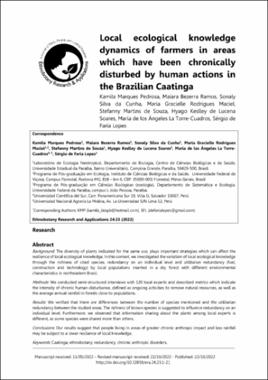
Local ecological knowledge dynamics of farmers in areas which have been chronically disturbed by human actions in the Brazilian Caatinga
| dc.contributor.author | Pedrosa, K.M. | |
| dc.contributor.author | Ramos, M.B. | |
| dc.contributor.author | da Cunha, S.S. | |
| dc.contributor.author | Maciel, M.G.R. | |
| dc.contributor.author | de Souza, S.M. | |
| dc.contributor.author | de Lucena Soares, H.K. | |
| dc.contributor.author | La Torre-Cuadros, M.Á. | |
| dc.contributor.author | de Faria Lopes, S. | |
| dc.date.accessioned | 2025-10-31T18:34:05Z | |
| dc.date.available | 2025-10-31T18:34:05Z | |
| dc.date.issued | 2022 | |
| dc.identifier.uri | https://hdl.handle.net/20.500.12805/5069 | |
| dc.description.abstract | Background: The diversity of plants indicated for the same use, plays important strategies which can affect the resilience of local ecological knowledge. In this context, we investigated the variation of local ecological knowledge through the richness of cited species, redundancy on an individual level and utilitarian redundancy (fuel, construction and technology) by local populations inserted in a dry forest with different environmental characteristics in northeastern Brazil. Methods: We conducted semi-structured interviews with 120 local experts and described metrics which indicate the intensity of chronic human disturbance, defined as ongoing activities to remove natural resources, as well as the average annual rainfall in forests close to populations. Results: We verified that there are differences between the number of species mentioned and the utilitarian redundancy between the studied areas. The richness of known species is suggested to influence redundancy on an individual level. Furthermore, we observed that information sharing about the plants among local experts is different, as some species were shared more than others. Conclusions: Our results suggest that people living in areas of greater chronic anthropic impact and less rainfall may be subject to a lower resilience of local knowledge. | en_US |
| dc.description.sponsorship | Funding text 1: List of abbreviations: LEC = local ecological knowledge, SDTFs = Seasonally Dry Tropical Forests, CAD = Chronic Anthropogenic Disturbances, A1; A2; A3; A4 and A5 = Study areas, ICF = Informed Consent Form, ICMBio/SISBIO = Chico Mendes Institute for Biodiversity Conservation, MMA = Ministry of the Environment, APG = Angiosperm Phylogeny Group, EcoTrocpis = Neotropical Ecology Laboratory, DGL = Diameter at Ground Level, DC = Nearest city, PH = Proximity to the Nearest rural property, TD = Trail density, DS = The density of households around the plot, LUSE = land use, NMDS = Non-Metric Multidimensional Scaling, UREDIT = Utility redundancy values, PERMANOVA = Permutational Multivariate Analysis of Variance, PCA = Principal Component Analysis and GLMM = Mixed-Effect Generalized Linear Models. Ethics approval and consent to participate: The study was conducted in accordance with the guidelines required by the National Health Council of Brazil through the Research Ethics Committee (resolution no. 466/12/CNS/MS; project approval protocol: 30657119.3.0000.5187). Consent for publication: Not applicable in this section. Consent for publication: Not applicable in this section. Availability of data and materials: Plant materials were prepared and deposited in the herbarium the Manuel de Arruda Câmara Herbarium, State University of Paraíba, Campus I, Campina Grande, Paraíba, Brazil. Competing interests: The authors declare that they have no conflicts of interest. Funding: This study was funded by Research Support Foundation of the State of Paraíba. Author contributions: KMP, MBR and SFL conceived the research idea. KMP, MBR, SSC, SMS and MGRM did the data collection. KMP analyzed and interpreted the data. HKLS Statistical analysis review. KMP, SFL and MALTC revised and improved the manuscript. All the authors read, reviewed, and approved the final version of the manuscript.; Funding text 2: The authors thank the informants of the rural communities who kindly agreed to participate in the research. To Professor José Iranildo Miranda de Melo for his assistance in the identification of botanical species. And to all the members of the Laboratory of Neotropical Ecology for their contributions to data collection. We thank the reviewers for their suggestions. MBR and KMP acknowledge the Fundação de Apoio à Pesquisa do Estado da Paraíba (FAPESq) for granting research scholarships. This study was partly financed by the Universidade Estadual da Paraíba grant 03/2022. SFL thanks CNPq for a productivity grant. | |
| dc.format | application/pdf | |
| dc.language.iso | eng | |
| dc.publisher | Department of Ethnobotany, Institute of Botany, Ilia State University | |
| dc.relation.ispartof | urn:issn:1547-3465 | |
| dc.rights | https://purl.org/coar/access_right/c_abf2 | |
| dc.rights.uri | https://creativecommons.org/licenses/by-nc-sa/4.0/ | |
| dc.subject | Ethnopharmacology and Biodiversity in Traditional Medicine | en_US |
| dc.subject | Cultural Resilience in Medicinal Plant Practices | en_US |
| dc.title | Local ecological knowledge dynamics of farmers in areas which have been chronically disturbed by human actions in the Brazilian Caatinga | en_US |
| dc.type | https://purl.org/coar/resource_type/c_2df8fbb1 | |
| dc.identifier.doi | https://doi.org/10.32859/era.24.23.1-21 | |
| dc.subject.ocde | https://purl.org/pe-repo/ocde/ford#1.06.13 | |
| dc.type.other | Research article | |
| dc.identifier.journal | Ethnobotany Research and Applications | |
| dc.type.version | https://purl.org/coar/version/c_970fb48d4fbd8a85 |
Files in this item
This item appears in the following Collection(s)
-
Artículos de Investigación [1294]

Except where otherwise noted, this item's license is described as https://purl.org/coar/access_right/c_abf2