Associations between metabolic phenotypes and diabetes risk: A systematic review and meta-analysis
| dc.contributor.author | Vera-Ponce, V.J. | |
| dc.contributor.author | Loayza-Castro, J.A. | |
| dc.contributor.author | Zuzunaga-Montoya, F.E. | |
| dc.contributor.author | Torres-Malca, J.R. | |
| dc.contributor.author | García-Lara, R.A. | |
| dc.contributor.author | Iturregui-Paucar, C.R. | |
| dc.contributor.author | Manrique, E.J.O. | |
| dc.contributor.author | Valladares-Garrido, M.J. | |
| dc.contributor.author | De La Cruz-Vargas, J.A. | |
| dc.date.accessioned | 2025-10-31T18:34:02Z | |
| dc.date.available | 2025-10-31T18:34:02Z | |
| dc.date.issued | 2023 | |
| dc.identifier.uri | https://hdl.handle.net/20.500.12805/5060 | |
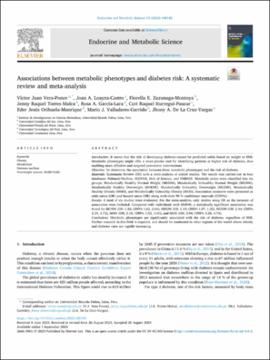
| dc.description.abstract | Introduction: It seems that the risk of developing diabetes cannot be predicted solely based on weight or BMI. Metabolic phenotypes might offer a more precise tool for identifying patients at higher risk of diabetes, thus enabling more effective and targeted preventive interventions. Objective: To determine the association between these metabolic phenotypes and the risk of diabetes. Materials: Systematic Review (SR) with a meta-analysis of cohort studies. The search was carried out in four databases: Pubmed/Medline, SCOPUS, Web of Science, and EMBASE. Metabolic states were classified into six groups: Metabolically Healthy Normal Weight (MHNW), Metabolically Unhealthy Normal Weight (MUNW), Metabolically Healthy Overweight (MHOW), Metabolically Unhealthy Overweight (MUOW), Metabolically Healthy Obesity (MHO), and Metabolically Unhealthy Obesity (MUO). Association measures were presented as odds ratios (OR) and hazard ratios (HR) along with their 95 % confidence intervals (CI95%). Results: A total of six studies were evaluated. For the meta-analysis, only studies using OR as the measure of association were included. Compared with individuals with MHNW, a statistically significant association was found for MUNW (OR: 1.82; CI95% 1.62, 2.04), MHOW (OR: 1.19; CI95% 1.07, 1.32), MUOW (OR: 2.44; CI95% 2.19, 2.72), MHO (OR: 2.14; CI95% 1.52, 3.01), and MUO (OR: 3.94; CI95% 3.28, 4.74). Conclusions: Metabolic phenotypes are significantly associated with the risk of diabetes, regardless of BMI. Further research in this field is required, and should be conducted in other regions of the world where obesity and diabetes rates are rapidly increasing. | en_US |
| dc.format | application/pdf | |
| dc.language.iso | eng | |
| dc.publisher | Elsevier | |
| dc.relation.ispartof | urn:issn:2666-3961 | |
| dc.rights | https://purl.org/coar/access_right/c_abf2 | |
| dc.rights.uri | https://creativecommons.org/licenses/by-nc-sa/4.0/ | |
| dc.subject | SDG 3 | en_US |
| dc.subject | Obesity, Metabolic Health, and Quality of Life | en_US |
| dc.subject | Metabolically Healthy Obesity and Associated Risks | en_US |
| dc.title | Associations between metabolic phenotypes and diabetes risk: A systematic review and meta-analysis | en_US |
| dc.type | https://purl.org/coar/resource_type/c_2df8fbb1 | |
| dc.identifier.doi | https://doi.org/10.1016/j.endmts.2023.100142 | |
| dc.subject.ocde | https://purl.org/pe-repo/ocde/ford#3.02.18 | |
| dc.type.other | Research article | |
| dc.identifier.journal | Endocrine and Metabolic Science | |
| dc.type.version | https://purl.org/coar/version/c_970fb48d4fbd8a85 |
Files in this item
This item appears in the following Collection(s)
-
Artículos de Investigación [1294]

Except where otherwise noted, this item's license is described as https://purl.org/coar/access_right/c_abf2