Análisis bibliométrico de la producción científica mundial sobre el aula invertida en la educación médica
| dc.contributor.author | Muñoz-Estrada, G.K. | |
| dc.contributor.author | Chumpitaz Caycho, H.E. | |
| dc.contributor.author | Barja-Ore, J. | |
| dc.contributor.author | Valverde-Espinoza, N. | |
| dc.contributor.author | Verde-Vargas, L. | |
| dc.contributor.author | Mayta-Tovalino, F. | |
| dc.date.accessioned | 2025-10-31T18:33:58Z | |
| dc.date.available | 2025-10-31T18:33:58Z | |
| dc.date.issued | 2022 | |
| dc.identifier.uri | https://hdl.handle.net/20.500.12805/5048 | |
| dc.description.abstract | Background: The flipped classroom is a new educational technology strategy, based on a constructivist approach that promotes active student participation. Therefore, the objective of the study was to analyze the bibliometric indicators of the scientific production on the flipped classroom in medical education. Method: Descriptive and retrospective bibliometric study, based on the scientific publications of journals indexed in Scopus from 2012 to 2021. A search strategy was developed with MESH terms and Boolean operators (“AND” and “OR”). The bibliometric metrics were performed with Elsevier's SciVal program. Results: 41.8% and 28.3% of the publications were in Q1 and Q2 quartile journals, respectively. In addition, Harvard University is the one with the most publications (15), but the University of North Carolina has the greatest impact (54.7 citations per publication). The journal Academic Medicine (Q1) and Academic Radiology (Q1) presented more citations per publication, with 79.9 and 42.2, respectively. 35.3% of the publications have national collaboration and 13.4% international. The author Zheng Binbin (FWCI: 4.64) is the one with the highest number of expected citations compared to the world average. Conclusions: There is a favorable trend in the number of publications with greater emphasis on high impact journals (Q1 and Q2). The authors and institutions with the most production were those from the United States and the most frequent type of collaboration was institutional. | en_US |
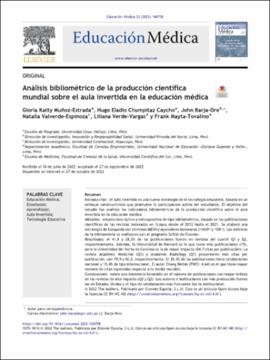
| dc.description.abstract | Introducción: el aula invertida es una nueva estrategia de la tecnología educativa, basada en un enfoque constructivista que promueve la participación activa del estudiante. El objetivo del estudio fue analizar los indicadores bibliométricos de la producción científica sobre el aula invertida en la educación médica. Métodos: estudio descriptivo y retrospectivo de tipo bibliométrico, basado en las publicaciones científicas de las revistas indexadas en Scopus desde el 2012 hasta el 2021. Se elaboró una estrategia de búsqueda con términos MESH y operadores booleanos («AND» y «OR»). Las métricas de la bibliometría se realizaron con el programa SciVal de Elsevier. Resultados: el 41,8 y 28,3% de las publicaciones fueron en revistas del cuartil Q1 y Q2, respectivamente. Además, la Universidad de Harvard es la que tiene más publicaciones (15), pero la Universidad del Norte de Carolina es la de mayor impacto (54,7 citas por publicación). La revista Academic Medicine (Q1) y Academic Radiology (Q1) presentaron más citas por publicación, con 79,9 y 42,2, respectivamente. El 35,3% de las publicaciones tiene colaboración nacional y 13,4% de tipo internacional. El autor Zheng Binbin (FWCI: 4,64) es el que tiene mayor número de citas esperadas respecto a la media mundial. Conclusiones: existe una tendencia favorable en el número de publicaciones con mayor énfasis en las revistas de alto impacto (Q1 y Q2). Los autores e instituciones con más producción fueron los de Estados Unidos y el tipo de colaboración más frecuente fue la institucional. | es_PE |
| dc.format | application/pdf | |
| dc.language.iso | spa | |
| dc.publisher | Elsevier | |
| dc.relation.ispartof | urn:issn:1575-1813 | |
| dc.rights | https://purl.org/coar/access_right/c_abf2 | |
| dc.rights.uri | https://creativecommons.org/licenses/by-nc-sa/4.0/ | |
| dc.subject | Innovative Approaches in Medical Education and Learning | en_US |
| dc.subject | Flipped Classroom Models in Higher Education | en_US |
| dc.title | Análisis bibliométrico de la producción científica mundial sobre el aula invertida en la educación médica | es_PE |
| dc.title.alternative | Bibliometric analysis of the world scientific production on the flipped classroom in medical education | en_US |
| dc.type | https://purl.org/coar/resource_type/c_2df8fbb1 | |
| dc.identifier.doi | https://doi.org/10.1016/j.edumed.2022.100758 | |
| dc.subject.ocde | https://purl.org/pe-repo/ocde/ford#5.03.01 | |
| dc.type.other | Research article | |
| dc.identifier.journal | Educacion Medica | |
| dc.type.version | https://purl.org/coar/version/c_970fb48d4fbd8a85 |
Files in this item
This item appears in the following Collection(s)
-
Artículos de Investigación [1294]

Except where otherwise noted, this item's license is described as https://purl.org/coar/access_right/c_abf2