Natural infection by Zika virus but not DNA vaccination consistently elicits antibodies that compete with two potently neutralising monoclonal antibodies targeting distinct epitopes
| dc.contributor.author | Smith, T.C. | |
| dc.contributor.author | Espinoza, D.O. | |
| dc.contributor.author | Zhu, Y. | |
| dc.contributor.author | Cardona-Ospina, J.A. | |
| dc.contributor.author | Bowman, N.M. | |
| dc.contributor.author | Becker-Dreps, S. | |
| dc.contributor.author | Rouphael, N. | |
| dc.contributor.author | Rodriguez-Morales, A.J. | |
| dc.contributor.author | Bucardo, F. | |
| dc.contributor.author | Edupuganti, S. | |
| dc.contributor.author | Premkumar, L. | |
| dc.contributor.author | Mulligan, M.J. | |
| dc.contributor.author | de Silva, A.M. | |
| dc.contributor.author | Collins, M.H. | |
| dc.date.accessioned | 2025-10-31T18:33:55Z | |
| dc.date.available | 2025-10-31T18:33:55Z | |
| dc.date.issued | 2023 | |
| dc.identifier.uri | https://hdl.handle.net/20.500.12805/5037 | |
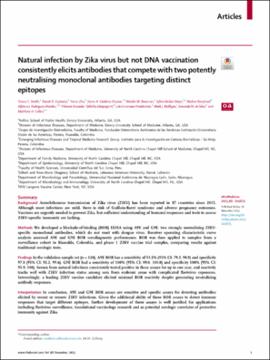
| dc.description.abstract | Background: Autochthonous transmission of Zika virus (ZIKV) has been reported in 87 countries since 2015. Although most infections are mild, there is risk of Guillain-Barré syndrome and adverse pregnancy outcomes. Vaccines are urgently needed to prevent Zika, but sufficient understanding of humoral responses and tools to assess ZIKV-specific immunity are lacking. Methods: We developed a blockade-of-binding (BOB) ELISA using A9E and G9E, two strongly neutralising ZIKV-specific monoclonal antibodies, which do not react with dengue virus. Receiver operating characteristic curve analysis assessed A9E and G9E BOB serodiagnostic performance. BOB was then applied to samples from a surveillance cohort in Risaralda, Colombia, and phase 1 ZIKV vaccine trial samples, comparing results against traditional serologic tests. Findings: In the validation sample set (n = 120), A9E BOB has a sensitivity of 93.5% (95% CI: 79.3, 98.9) and specificity 97.8 (95% CI: 92.2, 99.6). G9E BOB had a sensitivity of 100% (95% CI: 89.0, 100.0) and specificity 100% (95% CI: 95.9, 100). Serum from natural infections consistently tested positive in these assays for up to one year, and reactivity tracks well with ZIKV infection status among sera from endemic areas with complicated flavivirus exposures. Interestingly, a leading ZIKV vaccine candidate elicited minimal BOB reactivity despite generating neutralising antibody responses. Interpretation: In conclusion, A9E and G9E BOB assays are sensitive and specific assays for detecting antibodies elicited by recent or remote ZIKV infections. Given the additional ability of these BOB assays to detect immune responses that target different epitopes, further development of these assays is well justified for applications including flavivirus surveillance, translational vaccinology research and as potential serologic correlates of protective immunity against Zika. Funding: R21 AI129532 (PI: S. Becker-Dreps), CDC BAA 2017-N-18041 (PI: A. M. de Silva), Thrasher Fund (PI: M. H. Collins), K22 AI137306 (PI: M. H. Collins). | en_US |
| dc.description.sponsorship | Funding text 1: R21 AI129532 (PI: S. Becker-Dreps), CDC BAA 2017-N-18041 (PI: A. M. de Silva), Thrasher Fund (PI: M. H. Collins), K22 AI137306 (PI: M. H. Collins).We thank the many that participated in clinical research studies and consented to future use of samples to make this study possible. We thank Sci-Help, S.A.S. and the field team in Risaralda, Colombia managing cohort studies. We thank the Vaccine Research Center of the NIH for sharing samples from VRC320: Grace Chen, Principal Investigator; Ro Rothwell, Protocol Specialist; Laura Novik, VRC Study Coordinator. We thank Dr. Josephine Cox for assistance procuring samples from VRC320 and for critical feedback on the manuscript. We thank Dr. Lilin Lai for assistance procuring samples from travellers. We thank Drs. Christina Mehta and Bidemi Yusuf for thoughtful input on biostatistical approaches and analyses used in this study. We acknowledge several funding sources: R21 AI129532 (PI: S. Becker-Dreps), CDC BAA 2017-N-18041 (PI: A. M. de Silva), Minciencias, Convocatoria 897 de 2021, Project 85982 (PI: J. A. Cardona-Ospina), Thrasher Fund (PI: M. H. Collins), K22 AI137306 (PI: M. H. Collins).; Funding text 2: We thank the many that participated in clinical research studies and consented to future use of samples to make this study possible. We thank Sci-Help, S.A.S. and the field team in Risaralda, Colombia managing cohort studies. We thank the Vaccine Research Center of the NIH for sharing samples from VRC320: Grace Chen, Principal Investigator; Ro Rothwell, Protocol Specialist; Laura Novik, VRC Study Coordinator. We thank Dr. Josephine Cox for assistance procuring samples from VRC320 and for critical feedback on the manuscript. We thank Dr. Lilin Lai for assistance procuring samples from travellers. We thank Drs. Christina Mehta and Bidemi Yusuf for thoughtful input on biostatistical approaches and analyses used in this study. We acknowledge several funding sources: R21 AI129532 (PI: S. Becker-Dreps), CDC BAA 2017-N-18041 (PI: A. M. de Silva), Minciencias , Convocatoria 897 de 2021, Project 85982 (PI: J. A. Cardona-Ospina), Thrasher Fund (PI: M. H. Collins), K22 AI137306 (PI: M. H. Collins). | |
| dc.format | application/pdf | |
| dc.language.iso | eng | |
| dc.publisher | Elsevier | |
| dc.relation.ispartof | urn:issn:2352-3964 | |
| dc.rights | https://purl.org/coar/access_right/c_abf2 | |
| dc.rights.uri | https://creativecommons.org/licenses/by-nc-sa/4.0/ | |
| dc.subject | SDG 3 | en_US |
| dc.subject | Dengue and Zika Virus Dynamics in Public Health | en_US |
| dc.subject | Zika Virus Impact on Congenital Health Outcomes | en_US |
| dc.title | Natural infection by Zika virus but not DNA vaccination consistently elicits antibodies that compete with two potently neutralising monoclonal antibodies targeting distinct epitopes | en_US |
| dc.type | https://purl.org/coar/resource_type/c_2df8fbb1 | |
| dc.identifier.doi | https://doi.org/10.1016/j.ebiom.2023.104875 | |
| dc.subject.ocde | https://purl.org/pe-repo/ocde/ford#1.06.02 | |
| dc.type.other | Research article | |
| dc.identifier.journal | eBioMedicine | |
| dc.type.version | https://purl.org/coar/version/c_970fb48d4fbd8a85 |
Files in this item
This item appears in the following Collection(s)
-
Artículos de Investigación [1294]

Except where otherwise noted, this item's license is described as https://purl.org/coar/access_right/c_abf2