Use of continuous glucose monitors in low- and middle-income countries: A scoping review
| dc.contributor.author | Bernabe-Ortiz, A. | |
| dc.contributor.author | Carrillo-Larco, R.M. | |
| dc.contributor.author | Safary, E. | |
| dc.contributor.author | Vetter, B. | |
| dc.contributor.author | Lazo-Porras, M. | |
| dc.date.accessioned | 2025-10-31T18:33:52Z | |
| dc.date.available | 2025-10-31T18:33:52Z | |
| dc.date.issued | 2023 | |
| dc.identifier.uri | https://hdl.handle.net/20.500.12805/5028 | |
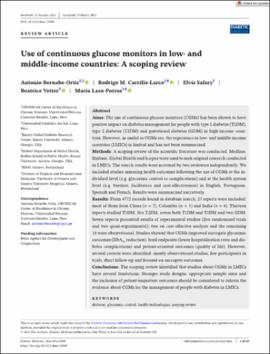
| dc.description.abstract | Aims: The use of continuous glucose monitors (CGMs) has been shown to have positive impact on diabetes management for people with type 1 diabetes (T1DM), type 2 diabetes (T2DM) and gestational diabetes (GDM) in high-income countries. However, as useful as CGMs are, the experience in low- and middle-income countries (LMICs) is limited and has not been summarized. Methods: A scoping review of the scientific literature was conducted. Medline, Embase, Global Health and Scopus were used to seek original research conducted in LMICs. The search results were screened by two reviewers independently. We included studies assessing health outcomes following the use of CGMs at the individual level (e.g. glycaemic control or complications) and at the health system level (e.g. barriers, facilitators and cost-effectiveness) in English, Portuguese, Spanish and French. Results were summarized narratively. Results: From 4772 records found in database search, 27 reports were included; most of them from China (n = 7), Colombia (n = 5) and India (n = 4). Thirteen reports studied T1DM, five T2DM, seven both T1DM and T2DM and two GDM. Seven reports presented results of experimental studies (five randomized trials and two quasi-experimental); two on cost-effective analysis and the remaining 18 were observational. Studies showed that CGMs improved surrogate glycaemic outcomes (HbA<inf>1c</inf> reduction), hard endpoints (lower hospitalization rates and diabetes complications) and patient-oriented outcomes (quality of life). However, several caveats were identified: mostly observational studies, few participants in trials, short follow-up and focused on surrogate outcomes. Conclusions: The scoping review identified that studies about CGMs in LMICs have several limitations. Stronger study designs, appropriate sample sizes and the inclusion of patient-important outcomes should be considered to inform the evidence about CGMs for the management of people with diabetes in LMICs. | en_US |
| dc.description.sponsorship | Funding was provided by FIND, the global alliance for diagnostic, through a grant from the Swiss Agency for Development and Cooperation (SDC). | |
| dc.format | application/pdf | |
| dc.language.iso | eng | |
| dc.publisher | John Wiley and Sons | |
| dc.relation.ispartof | urn:issn:1464-5491 | |
| dc.rights | https://purl.org/coar/access_right/c_abf2 | |
| dc.rights.uri | https://creativecommons.org/licenses/by-nc-sa/4.0/ | |
| dc.subject | SDG 3 | en_US |
| dc.subject | Innovative Approaches in Diabetes Management and Monitoring | en_US |
| dc.subject | Continuous Glucose Monitoring in Diabetes Management | en_US |
| dc.title | Use of continuous glucose monitors in low- and middle-income countries: A scoping review | en_US |
| dc.type | https://purl.org/coar/resource_type/c_2df8fbb1 | |
| dc.identifier.doi | https://doi.org/10.1111/dme.15089 | |
| dc.subject.ocde | https://purl.org/pe-repo/ocde/ford#3.03.05 | |
| dc.type.other | Research article | |
| dc.identifier.journal | Diabetic Medicine | |
| dc.type.version | https://purl.org/coar/version/c_970fb48d4fbd8a85 |
Files in this item
This item appears in the following Collection(s)
-
Artículos de Investigación [1294]

Except where otherwise noted, this item's license is described as https://purl.org/coar/access_right/c_abf2