Exploring the adjustment to parasite pressure hypothesis: Differences in uropygial gland volume and haemosporidian infection in palearctic and neotropical birds
| dc.contributor.author | Magallanes, S. | |
| dc.contributor.author | Moller, A.P. | |
| dc.contributor.author | Lujan-Vega, C. | |
| dc.contributor.author | Fong, E. | |
| dc.contributor.author | Vecco, D. | |
| dc.contributor.author | Flores-Saavedra, W. | |
| dc.contributor.author | García-Longoriaa, L. | |
| dc.contributor.author | de Lope, F. | |
| dc.contributor.author | Iannacone, J.A. | |
| dc.contributor.author | Marzal, A. | |
| dc.date.accessioned | 2025-10-31T18:33:49Z | |
| dc.date.available | 2025-10-31T18:33:49Z | |
| dc.date.issued | 2021 | |
| dc.identifier.uri | https://hdl.handle.net/20.500.12805/5019 | |
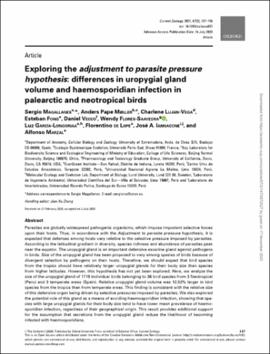
| dc.description.abstract | Parasites are globally widespread pathogenic organisms, which impose important selective forces upon their hosts. Thus, in accordance with the Adjustment to parasite pressure hypothesis, it is expected that defenses among hosts vary relative to the selective pressure imposed by parasites. According to the latitudinal gradient in diversity, species richness and abundance of parasites peak near the equator. The uropygial gland is an important defensive exocrine gland against pathogens in birds. Size of the uropygial gland has been proposed to vary among species of birds because of divergent selection by pathogens on their hosts. Therefore, we should expect that bird species from the tropics should have relatively larger uropygial glands for their body size than species from higher latitudes. However, this hypothesis has not yet been explored. Here, we analyze the size of the uropygial gland of 1719 individual birds belonging to 36 bird species from 3 Neotropical (Peru) and 3 temperate areas (Spain). Relative uropygial gland volume was 12.52% larger in bird species from the tropics than from temperate areas. This finding is consistent with the relative size of this defensive organ being driven by selective pressures imposed by parasites. We also explored the potential role of this gland as a means of avoiding haemosporidian infection, showing that species with large uropygial glands for their body size tend to have lower mean prevalence of haemosporidian infection, regardless of their geographical origin. This result provides additional support for the assumption that secretions from the uropygial gland reduce the likelihood of becoming infected with haemosporidians. | en_US |
| dc.description.sponsorship | This work was supported by the Spanish Ministry of Economy and Competitiveness research projects [grant CGL2015-64650P] and Junta de Extremadura [grant IB16121]. S.M. and A.M. were supported by a Ph.D. grant from the Ministry of Economy and Competition of Spain and a mobility grant of Junta de Extremadura (129/2015), respectively. L.G.-L. was supported by the Junta de Extremadura [PO17024, Post-Doc grant]. | |
| dc.format | application/pdf | |
| dc.language.iso | eng | |
| dc.publisher | Oxford University Press | |
| dc.relation.ispartof | urn:issn:1674-5507 | |
| dc.rights | https://purl.org/coar/access_right/c_abf2 | |
| dc.rights.uri | https://creativecommons.org/licenses/by-nc-sa/4.0/ | |
| dc.subject | SDG 3 | en_US |
| dc.subject | Interplay of Behavior and Coloration in Species | en_US |
| dc.subject | Olfactory Communication and Microbial Interactions in Birds | en_US |
| dc.title | Exploring the adjustment to parasite pressure hypothesis: Differences in uropygial gland volume and haemosporidian infection in palearctic and neotropical birds | en_US |
| dc.type | https://purl.org/coar/resource_type/c_2df8fbb1 | |
| dc.identifier.doi | https://doi.org/10.1093/cz/zoaa037 | |
| dc.subject.ocde | https://purl.org/pe-repo/ocde/ford#1.06.11 | |
| dc.type.other | Research article | |
| dc.identifier.journal | Current Zoology | |
| dc.type.version | https://purl.org/coar/version/c_970fb48d4fbd8a85 |
Files in this item
This item appears in the following Collection(s)
-
Artículos de Investigación [1294]

Except where otherwise noted, this item's license is described as https://purl.org/coar/access_right/c_abf2