The patient-centered medical home as an intervention strategy for diabetes mellitus: A systematic review of the literature
| dc.contributor.author | McManus, L.S. | |
| dc.contributor.author | Dominguez-Cancino, K.A. | |
| dc.contributor.author | Stanek, M.K. | |
| dc.contributor.author | Leyva-Moral, J.M. | |
| dc.contributor.author | Bravo-Tare, C.E. | |
| dc.contributor.author | Rivera-Lozada, O. | |
| dc.contributor.author | Palmieri, P.A. | |
| dc.date.accessioned | 2025-10-31T18:33:48Z | |
| dc.date.available | 2025-10-31T18:33:48Z | |
| dc.date.issued | 2021 | |
| dc.identifier.uri | https://hdl.handle.net/20.500.12805/5016 | |
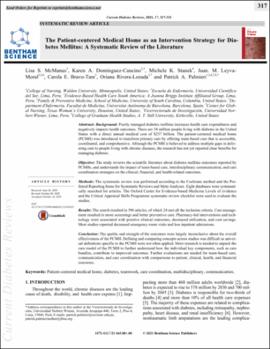
| dc.description.abstract | Background: Poorly managed diabetes mellitus increases health care expenditures and negatively impacts health outcomes. There are 34 million people living with diabetes in the United States with a direct annual medical cost of $237 billion. The patient-centered medical home (PCMH) was introduced to transform primary care by offering team-based care that is accessible, coordinated, and comprehensive. Although the PCMH is believed to address multiple gaps in delivering care to people living with chronic diseases, the research has not yet reported clear benefits for managing diabetes. Objective: The study reviews the scientific literature about diabetes mellitus outcomes reported by PCMHs, and understands the impact of team-based care, interdisciplinary communication, and care coordination strategies on the clinical, financial, and health-related outcomes. Methods: The systematic review was performed according to the Cochrane method and the Preferred Reporting Items for Systematic Reviews and Meta-Analyses. Eight databases were systematically searched for articles. The Oxford Centre for Evidence-based Medicine Levels of evidence and the Critical Appraisal Skills Programme systematic review checklist were used to evaluate the studies. Results: The search resulted in 596 articles, of which 24 met all the inclusion criteria. Care management resulted in more screenings and better preventive care. Pharmacy-led interventions and technology were associated with positive clinical outcomes, decreased utilization, and cost savings. Most studies reported decreased emergency room visits and less inpatient admissions. Conclusion: The quality and strength of the outcomes were largely inconclusive about the overall effectiveness of the PCMH. Defining and comparing concepts across studies was difficult as universal definitions specific to the PCMH were not often applied. More research is needed to unpack the care model of the PCMH to further understand how the individual key components, such as care bundles, contribute to improved outcomes. Further evaluations are needed for team-based care, communication, and care coordination with comparisons to patient, clinical, health, and financial outcomes. | en_US |
| dc.format | application/pdf | |
| dc.language.iso | eng | |
| dc.publisher | Bentham Science Publishers | |
| dc.relation.ispartof | urn:issn:1573-3998 | |
| dc.rights | https://purl.org/coar/access_right/c_abf2 | |
| dc.rights.uri | https://creativecommons.org/licenses/by-nc-sa/4.0/ | |
| dc.subject | SDG 3 | en_US |
| dc.subject | Enhancing Primary Health Care through Innovative Practices | en_US |
| dc.subject | Patient-Centered Medical Home Models in Healthcare | en_US |
| dc.title | The patient-centered medical home as an intervention strategy for diabetes mellitus: A systematic review of the literature | en_US |
| dc.type | https://purl.org/coar/resource_type/c_2df8fbb1 | |
| dc.identifier.doi | https://doi.org/10.2174/1573399816666201123103835 | |
| dc.subject.ocde | https://purl.org/pe-repo/ocde/ford#3.03.05 | |
| dc.type.other | Research article | |
| dc.identifier.journal | Current Diabetes Reviews | |
| dc.type.version | https://purl.org/coar/version/c_970fb48d4fbd8a85 |
Files in this item
This item appears in the following Collection(s)
-
Artículos de Investigación [1294]

Except where otherwise noted, this item's license is described as https://purl.org/coar/access_right/c_abf2