Peripheral CD4+CD28null T-cells as predictors of damage in systemic lupus erythematosus patients
| dc.contributor.author | Ugarte-Gil, M.F. | |
| dc.contributor.author | Sánchez-Zúñiga, C. | |
| dc.contributor.author | Gamboa-Cardenas, R.V. | |
| dc.contributor.author | Aliaga-Zamudio, M. | |
| dc.contributor.author | Zevallos, F. | |
| dc.contributor.author | Mosqueira-Riveros, A. | |
| dc.contributor.author | Medina-Chinchón, M. | |
| dc.contributor.author | Tineo-Pozo, G. | |
| dc.contributor.author | Elera-Fitzcarrald, C. | |
| dc.contributor.author | Pimentel-Quiroz, V. | |
| dc.contributor.author | Sarmiento-Velasquez, O. | |
| dc.contributor.author | Reátegui-Sokolova, C. | |
| dc.contributor.author | Cucho-Venegas, J.M. | |
| dc.contributor.author | Alfaro-Lozano, J. | |
| dc.contributor.author | Rodriguez-Bellido, Z. | |
| dc.contributor.author | Pastor-Asurza, C. | |
| dc.contributor.author | Alarcón, G.S. | |
| dc.contributor.author | Perich-Campos, R. | |
| dc.date.accessioned | 2025-10-31T18:33:44Z | |
| dc.date.available | 2025-10-31T18:33:44Z | |
| dc.date.issued | 2018 | |
| dc.identifier.uri | https://www.clinexprheumatol.org/abstract.asp?a=12285 | |
| dc.identifier.uri | https://hdl.handle.net/20.500.12805/5001 | |
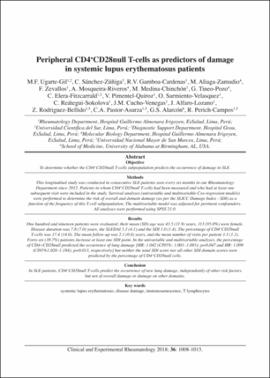
| dc.description.abstract | Objetives: To determine whether the CD4+CD28null T-cells subpopulation predicts the occurrence of damage in SLE. Methods: This longitudinal study was conducted in consecutive SLE patients seen every six months in our Rheumatology Department since 2012. Patients in whom CD4+CD28null T-cells had been measured and who had at least one subsequent visit were included in the study. Survival analyses (univariable and multivariable Cox-regression models) were performed to determine the risk of overall and domain damage (as per the SLICC Damage Index - SDI) as a function of the frequency of this T-cell subpopulation. The multivariable model was adjusted for pertinent confounders. All analyses were performed using SPSS 21.0. RESULTS: One hundred and nineteen patients were evaluated; their mean (SD) age was 43.5 (11.9) years, 113 (95.0%) were female. Disease duration was 7.8 (7.0) years, the SLEDAI 5.3 (4.1) and the SDI 1.0 (1.4). The percentage of CD4+CD28null T-cells was 17.4 (14.0). The mean follow-up was 2.1 (0.8) years, and the mean number of visits per patient 3.5 (1.1). Forty-six (38.7%) patients increase at least one SDI point. In the univariable and multivariable analyses, the percentage of CD4+CD28null predicted the occurrence of lung damage [HR: 1.042 (CI95%: 1.001-1.085); p=0.047 and HR: 1.099 (CI95%1.020-1.184); p=0.013, respectively] but neither the total SDI score nor all other SDI domain scores were predicted by the percentage of CD4+CD28null cells. CONCLUSIONS: In SLE patients, CD4+CD28null T-cells predict the occurrence of new lung damage, independently of other risk factors but not of overall damage or damage on other domains. | en_US |
| dc.format | application/pdf | |
| dc.language.iso | eng | |
| dc.publisher | NLM | |
| dc.relation.ispartof | urn:issn:1593-098X | |
| dc.rights | https://purl.org/coar/access_right/c_abf2 | |
| dc.rights.uri | https://creativecommons.org/licenses/by-nc-sa/4.0/ | |
| dc.subject | Systemic Lupus Erythematosus and Patient Outcomes | en_US |
| dc.subject | Systemic Lupus Erythematosus and Arthropathy | en_US |
| dc.title | Peripheral CD4+CD28null T-cells as predictors of damage in systemic lupus erythematosus patients | en_US |
| dc.type | https://purl.org/coar/resource_type/c_2df8fbb1 | |
| dc.subject.ocde | https://purl.org/pe-repo/ocde/ford#3.02.17 | |
| dc.type.other | Research article | |
| dc.identifier.journal | Clinical and experimental rheumatology | |
| dc.type.version | https://purl.org/coar/version/c_970fb48d4fbd8a85 |
Files in this item
This item appears in the following Collection(s)
-
Artículos de Investigación [1294]

Except where otherwise noted, this item's license is described as https://purl.org/coar/access_right/c_abf2