Association between total available nutritional quality and food expenditure in Peruvian households, 2019-2020
| dc.contributor.author | Bonilla-Aguilar, K. | |
| dc.contributor.author | Bernabe-Ortiz, A. | |
| dc.date.accessioned | 2025-10-31T18:33:37Z | |
| dc.date.available | 2025-10-31T18:33:37Z | |
| dc.date.issued | 2023 | |
| dc.identifier.uri | https://hdl.handle.net/20.500.12805/4980 | |
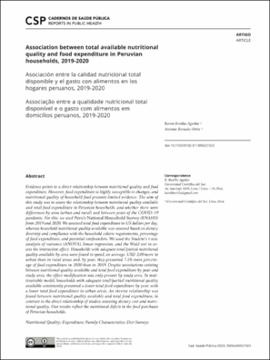
| dc.description.abstract | Evidence points to a direct relationship between nutritional quality and food expenditure. However, food expenditure is highly susceptible to changes, and nutritional quality of household food presents limited evidence. The aim of this study was to assess the relationship between nutritional quality available and total food expenditure in Peruvian households, and whether there were differences by area (urban and rural) and between years of the COVID-19 pandemic. For this, we used Peru’s National Household Survey (ENAHO) from 2019 and 2020. We assessed total food expenditure in US dollars per day, whereas household nutritional quality available was assessed based on dietary diversity and compliance with the household calorie requirements, percentage of food expenditure, and potential confounders. We used the Student’s t-test, analysis of variance (ANOVA), linear regression, and the Wald test to assess the interaction effect. Households with adequate total/partial nutritional quality available by area were found to spend, on average, USD 2.00 more in urban than in rural areas and, by year, they presented 7.1% more percentage of food expenditure in 2020 than in 2019. Despite associations existing between nutritional quality available and total food expenditure by year and study area, the effect modification was only present by study area. In multivariable model, households with adequate total/partial nutritional quality available consistently presented a lower total food expenditure by year, with a lower total food expenditure in urban areas. An inverse relationship was found between nutritional quality available and total food expenditure, in contrast to the direct relationship of studies assessing dietary cost and nutritional quality. Our results reflect the nutritional deficit in the food purchases of Peruvian households. | en_US |
| dc.description.sponsorship | To the Master’s program in Clinical Epidemiology and Biostatistics at the Southern Scientific University (Lima, Peru). | |
| dc.format | application/pdf | |
| dc.language.iso | eng | |
| dc.publisher | Fundacao Oswaldo Cruz | |
| dc.relation.ispartof | urn:issn:0102-311X | |
| dc.rights | https://purl.org/coar/access_right/c_abf2 | |
| dc.rights.uri | https://creativecommons.org/licenses/by-nc-sa/4.0/ | |
| dc.subject | Nutrition, Food Security, and Family Dynamics | en_US |
| dc.subject | Socioeconomic Influences on Healthy Diet Choices | en_US |
| dc.title | Association between total available nutritional quality and food expenditure in Peruvian households, 2019-2020 | en_US |
| dc.type | https://purl.org/coar/resource_type/c_2df8fbb1 | |
| dc.identifier.doi | https://doi.org/10.1590/0102-311XEN021923 | |
| dc.subject.ocde | https://purl.org/pe-repo/ocde/ford#3.03.04 | |
| dc.type.other | Research article | |
| dc.identifier.journal | Cadernos de Saude Publica | |
| dc.type.version | https://purl.org/coar/version/c_970fb48d4fbd8a85 |
Files in this item
This item appears in the following Collection(s)
-
Artículos de Investigación [1294]

Except where otherwise noted, this item's license is described as https://purl.org/coar/access_right/c_abf2