The association between maternal fears about their infant/ toddler during the COVID-19 pandemic and depression and anxiety: a birth cohort study
| dc.contributor.author | Foschiera, R.W. | |
| dc.contributor.author | Moro, J.P. | |
| dc.contributor.author | Getulino, F.A. | |
| dc.contributor.author | Carpena, M.X. | |
| dc.contributor.author | Costa, F.S. | |
| dc.contributor.author | Blumenberg, C. | |
| dc.contributor.author | Martins, R.C. | |
| dc.contributor.author | Martins-Silva, T. | |
| dc.contributor.author | Marmitt, L.P. | |
| dc.contributor.author | Goicochea, A. | |
| dc.contributor.author | Meucci, R. | |
| dc.contributor.author | Cesar, J. | |
| dc.contributor.author | Loret de Mola, C. | |
| dc.date.accessioned | 2025-10-31T18:33:37Z | |
| dc.date.available | 2025-10-31T18:33:37Z | |
| dc.date.issued | 2023 | |
| dc.identifier.uri | https://www.scielo.br/j/rbp/a/rDq4bNM5Bz7nNT7XqXWVsds | |
| dc.identifier.uri | https://hdl.handle.net/20.500.12805/4977 | |
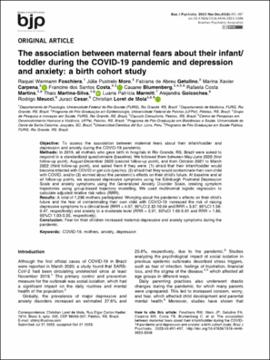
| dc.description.abstract | Objective: To assess the association between maternal fears about their infant/toddler and depression and anxiety during the COVID-19 pandemic. Methods: In 2019, all mothers who gave birth in hospitals in Rio Grande, RS, Brazil were asked to respond to a standardized questionnaire (baseline). We followed them between May-June 2020 (first follow-up point), August-December 2020 (second follow-up point), and from October 2021 to March 2022 (third follow-up point), and asked them if they were: (1) afraid that their infant/toddler would become infected with COVID or get sick (yes/no), (2) afraid that they would contaminate their own child with COVID, and/or (3) worried about the pandemic’s effects on their child’s future. At baseline and at all follow-up points, we assessed depressive symptoms using the Edinburgh Postnatal Depression Scale and anxiety symptoms using the Generalized Anxiety Disorder Scale, creating symptom trajectories using group-based trajectory modelling. We used multinomial logistic regression to calculate adjusted relative risk ratios (RRR). Results: A total of 1,296 mothers participated. Worrying about the pandemic’s effects on their child’s future and the fear of contaminating their own child with COVID-19 increased the risk of raising depressive symptoms to a clinical level (RRR = 4.97, 95%CI 2.32-10.64 and RRR = 3.87, 95%CI 1.58-9.47, respectively) and anxiety to a moderate level (RRR = 2.91, 95%CI 1.69-5.01 and RRR = 1.86, 95%CI 1.03-3.35, respectively). Conclusion: Fear for their children increased maternal depressive and anxiety symptoms during the pandemic. | en_US |
| dc.description.sponsorship | This study was funded by Conselho Nacional de Desenvolvimento Científico e Tecnológico (CNPq; grant 433426/2018-7) and Secretaria Municipal de Saúde de Rio Grande. The study was conducted in a graduate program supported by Coordenac¸ão de Aperfeic¸oamento de Pessoal de Nível Superior (CAPES; finance code 001). | |
| dc.format | application/pdf | |
| dc.language.iso | eng | |
| dc.publisher | Associacao Brasileira de Psiquiatria | |
| dc.relation.ispartof | urn:issn:1809-452X | |
| dc.rights | https://purl.org/coar/access_right/c_abf2 | |
| dc.rights.uri | https://creativecommons.org/licenses/by-nc-sa/4.0/ | |
| dc.subject | Postpartum Depression and Maternal Mental Health Insights | en_US |
| dc.subject | Mental Health Challenges for Pregnant Women During COVID-19 | en_US |
| dc.title | The association between maternal fears about their infant/ toddler during the COVID-19 pandemic and depression and anxiety: a birth cohort study | en_US |
| dc.type | https://purl.org/coar/resource_type/c_2df8fbb1 | |
| dc.subject.ocde | https://purl.org/pe-repo/ocde/ford#3.03.09 | |
| dc.type.other | Research article | |
| dc.identifier.journal | Brazilian Journal of Psychiatry | |
| dc.type.version | https://purl.org/coar/version/c_970fb48d4fbd8a85 |
Files in this item
This item appears in the following Collection(s)
-
Artículos de Investigación [1294]

Except where otherwise noted, this item's license is described as https://purl.org/coar/access_right/c_abf2