Maternal mental health before and during the COVID-19 pandemic in the 2019 rio grande birth cohort
| dc.contributor.author | de Mola, C.L. | |
| dc.contributor.author | Martins-Silva, T. | |
| dc.contributor.author | Carpena, M.X. | |
| dc.contributor.author | Del-Ponte, B. | |
| dc.contributor.author | Blumenberg, C. | |
| dc.contributor.author | Martins, R.C. | |
| dc.contributor.author | Dias, I.M. | |
| dc.contributor.author | Terribele, F.B. | |
| dc.contributor.author | de Avila, A.B. | |
| dc.contributor.author | Marmitt, L.P. | |
| dc.contributor.author | Meucci, R. | |
| dc.contributor.author | Cesar, J.A. | |
| dc.date.accessioned | 2025-10-31T18:33:36Z | |
| dc.date.available | 2025-10-31T18:33:36Z | |
| dc.date.issued | 2021 | |
| dc.identifier.uri | https://hdl.handle.net/20.500.12805/4975 | |
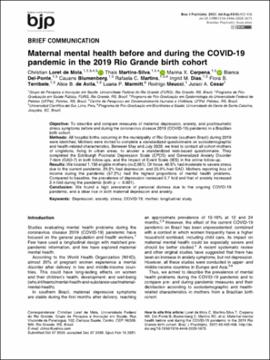
| dc.description.abstract | Objective: To describe and compare measures of maternal depression, anxiety, and posttraumatic stress symptoms before and during the coronavirus disease 2019 (COVID-19) pandemic in a Brazilian birth cohort. Methods: All hospital births occurring in the municipality of Rio Grande (southern Brazil) during 2019 were identified. Mothers were invited to complete a standardized questionnaire on sociodemographic and health-related characteristics. Between May and July 2020, we tried to contact all cohort mothers of singletons, living in urban areas, to answer a standardized web-based questionnaire. They completed the Edinburgh Postnatal Depression Scale (EPDS) and Generalized Anxiety Disorder 7-item (GAD-7) in both follow-ups, and the Impact of Event Scale (IES) in the online follow-up. Results: We located 1,136 eligible mothers (n=2,051). Of those, 40.5% had moderate to severe stress due to the current pandemic, 29.3% had depression, and 25.9% had GAD. Mothers reporting loss of income during the pandemic (57.2%) had the highest proportions of mental health problems. Compared to baseline, the prevalence of depression increased 5.7 fold and that of anxiety increased 2.4-fold during the pandemic (both p o 0.001). Conclusion: We found a high prevalence of personal distress due to the ongoing COVID-19 pandemic, and a clear rise in both maternal depression and anxiety. | en_US |
| dc.description.sponsorship | We would like to acknowledge the important contributions of Dr. Rebecca Pearson and Dr. Ana Luiza Soares for designing the questionnaire and comments. This study was funded by Conselho Nacional de Desenvolvimento Científico e Tecnológico (CNPq), grant number 433426/ 2018-7, and the Rio Grande Municipal Department of Health. The study was conducted within a graduate program supported by the Coordenac¸ão de Aper-feic¸oamento de Pessoal de Nível Superior (CAPES; finance code 001). | |
| dc.format | application/pdf | |
| dc.language.iso | eng | |
| dc.publisher | Associacao Brasileira de Psiquiatria | |
| dc.relation.ispartof | urn:issn:1809-452X | |
| dc.rights | https://purl.org/coar/access_right/c_abf2 | |
| dc.rights.uri | https://creativecommons.org/licenses/by-nc-sa/4.0/ | |
| dc.subject | Postpartum Depression and Maternal Mental Health Insights | en_US |
| dc.subject | Mental Health Challenges for Pregnant Women During COVID-19 | en_US |
| dc.title | Maternal mental health before and during the COVID-19 pandemic in the 2019 rio grande birth cohort | en_US |
| dc.type | https://purl.org/coar/resource_type/c_2df8fbb1 | |
| dc.identifier.doi | https://doi.org/10.1590/1516-4446-2020-1673 | |
| dc.subject.ocde | https://purl.org/pe-repo/ocde/ford#3.03.00 | |
| dc.type.other | Research article | |
| dc.identifier.journal | Brazilian Journal of Psychiatry | |
| dc.type.version | https://purl.org/coar/version/c_970fb48d4fbd8a85 |
Files in this item
This item appears in the following Collection(s)
-
Artículos de Investigación [1294]

Except where otherwise noted, this item's license is described as https://purl.org/coar/access_right/c_abf2