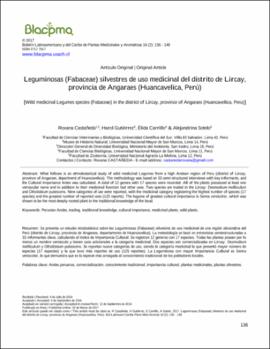
Leguminosas (Fabaceae) silvestres de uso medicinal del distrito de Lircay, provincia de Angaraes (Huancavelica, Perú)
| dc.contributor.author | Castañeda, R. | |
| dc.contributor.author | Gutiérrez, H. | |
| dc.contributor.author | Carrillo, É. | |
| dc.contributor.author | Sotelo, A. | |
| dc.date.accessioned | 2025-10-31T18:33:34Z | |
| dc.date.available | 2025-10-31T18:33:34Z | |
| dc.date.issued | 2017 | |
| dc.identifier.uri | https://blacpma.ms-editions.cl/index.php/blacpma/article/view/172 | |
| dc.identifier.uri | https://hdl.handle.net/20.500.12805/4969 | |
| dc.description.abstract | What follows is an ethnobotanical study of wild medicinal Legumes from a high Andean region of Peru (district of Lircay, province of Angaraes, department of Huancavelica). The methodology was based on 33 semi-structured interviews with key informants, and the Cultural Importance Index was calculated. A total of 12 genera with 17 species were recorded. All of the plants possessed at least one vernacular name and in addition to their medicinal function had other uses. Two species are traded in the Lircay: Desmodium molliculum and Otholobium pubescens. Nine categories of use were reported, with the medicinal category registering the highest number of species (17 species) and the greatest number of reported uses (125 reports). The legume of greatest cultural importance is Senna versicolor, which was shown to be the most deeply-rooted plant in the traditional knowledge of the local. | en_US |
| dc.description.abstract | Se presenta un estudio etnobotánico sobre las Leguminosas (Fabaceae) silvestres de uso medicinal de una región altoandina del Perú (distrito de Lircay, provincia de Angaraes, departamento de Huancavelica). La metodología se basó en entrevistas semiestructuradas a 33 informantes clave, calculando el índice de Importancia Cultural. Se registran 12 géneros con 17 especies. Todas las plantas poseen por lo menos un nombre vernáculo y tienen usos adicionales a la categoría medicinal. Dos especies son comercializadas en Lircay: Desmodium molliculumy Otholobium pubescens. Se reportan nueve categorías de uso, siendo la categoría medicinal la que presentó mayor número de especies (17 especies) y la que tuvo más reportes de uso (125 reportes). La Leguminosa con mayor Importancia Cultural es Senna versicolor, lo que demuestra que es la especie más arraigada al conocimiento tradicional de los pobladores locales. | es_PE |
| dc.format | application/pdf | |
| dc.language.iso | spa | |
| dc.publisher | Universidad de Santiago de Chile | |
| dc.relation.ispartof | urn:issn:0717-7917 | |
| dc.rights | https://purl.org/coar/access_right/c_abf2 | |
| dc.rights.uri | https://creativecommons.org/licenses/by-nc-sa/4.0/ | |
| dc.subject | Ethnopharmacology and Biodiversity in Traditional Medicine | en_US |
| dc.subject | Traditional Medicinal Plants and Their Cultural Significance | en_US |
| dc.title | Leguminosas (Fabaceae) silvestres de uso medicinal del distrito de Lircay, provincia de Angaraes (Huancavelica, Perú) | es_PE |
| dc.title.alternative | Wild medicinal Legumes species (Fabaceae) in the district of Lircay, province of Angaraes (Huancavelica, Peru) | en_US |
| dc.type | https://purl.org/coar/resource_type/c_2df8fbb1 | |
| dc.subject.ocde | https://purl.org/pe-repo/ocde/ford#5.00.00 | |
| dc.type.other | Research article | |
| dc.identifier.journal | Boletín Latinoamericano y del Caribe de Plantas Medicinales y Aromáticas | |
| dc.type.version | https://purl.org/coar/version/c_970fb48d4fbd8a85 |
Files in this item
This item appears in the following Collection(s)
-
Artículos de Investigación [1294]

Except where otherwise noted, this item's license is described as https://purl.org/coar/access_right/c_abf2