Agreement between the laboratory-based and non-laboratory-based WHO cardiovascular risk charts: a cross-sectional analysis of a national health survey in Peru
| dc.contributor.author | Guzman-Vilca, W.C. | |
| dc.contributor.author | Quispe-Villegas, G.A. | |
| dc.contributor.author | Váscones Román, F.F. | |
| dc.contributor.author | Bernabe-Ortiz, A. | |
| dc.contributor.author | Carrillo-Larco, R.M. | |
| dc.date.accessioned | 2025-10-31T18:33:32Z | |
| dc.date.available | 2025-10-31T18:33:32Z | |
| dc.date.issued | 2022 | |
| dc.identifier.uri | https://hdl.handle.net/20.500.12805/4962 | |
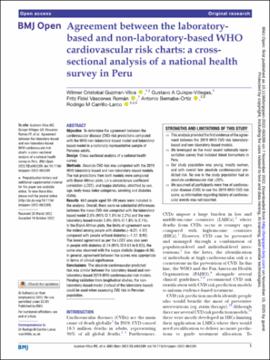
| dc.description.abstract | Objective To determine the agreement between the cardiovascular disease (CVD) risk predictions computed with the WHO non-laboratory-based model and laboratory-based model in a nationally representative sample of Peruvian adults. Design Cross-sectional analysis of a national health survey. Methods Absolute CVD risk was computed with the 2019 WHO laboratory-based and non-laboratory-based models. The risk predictions from both models were compared with Bland-Altman plots, Lin's concordance coefficient correlation (LCCC), and kappa statistics, stratified by sex, age, body mass index categories, smoking and diabetes status. Results 663 people aged 30-59 years were included in the analysis. Overall, there were no substantial differences between the mean CVD risk computed with the laboratory-based model 2.0% (95% CI 1.8% to 2.2%) and the non-laboratory-based model 2.0% (95% CI 1.8% to 2.1%). In the Bland-Altman plots, the limits of agreement were the widest among people with diabetes (-0.21; 4.37) compared with people without diabetes (-1.17; 0.95). The lowest agreement as per the LCCC was also seen in people with diabetes (0.74 (95% CI 0.63 to 0.82)), the same was observed with the kappa statistic (kappa=0.36). In general, agreement between the scores was appropriate in terms of clinical significance. Conclusions The absolute cardiovascular predicted risk was similar between the laboratory-based and non-laboratory-based 2019 WHO cardiovascular risk models. Pending validation from longitudinal studies, the non-laboratory-based model (instead of the laboratory-based) could be used when assessing CVD risk in Peruvian population. | en_US |
| dc.description.sponsorship | RMC-L is supported by a Wellcome Trust International Training Fellowship (214185/Z/18/Z). | |
| dc.format | application/pdf | |
| dc.language.iso | eng | |
| dc.publisher | BMJ Publishing Group | |
| dc.relation.ispartof | urn:issn:2044-6055 | |
| dc.rights | https://purl.org/coar/access_right/c_abf2 | |
| dc.rights.uri | https://creativecommons.org/licenses/by-nc-sa/4.0/ | |
| dc.subject | SDG 3 | en_US |
| dc.subject | Hypertension Management and Dietary Sodium Impact | en_US |
| dc.subject | Cardiovascular Risk Assessment and Management Strategies | en_US |
| dc.title | Agreement between the laboratory-based and non-laboratory-based WHO cardiovascular risk charts: a cross-sectional analysis of a national health survey in Peru | en_US |
| dc.type | https://purl.org/coar/resource_type/c_2df8fbb1 | |
| dc.identifier.doi | https://doi.org/10.1136/bmjopen-2022-063289 | |
| dc.subject.ocde | https://purl.org/pe-repo/ocde/ford#3.03.09 | |
| dc.type.other | Research article | |
| dc.identifier.journal | BMJ Open | |
| dc.type.version | https://purl.org/coar/version/c_970fb48d4fbd8a85 |
Files in this item
This item appears in the following Collection(s)
-
Artículos de Investigación [1294]

Except where otherwise noted, this item's license is described as https://purl.org/coar/access_right/c_abf2