Sociodemographic factors associated to knowledge and attitudes towards dengue prevention among the Peruvian population: findings from a national survey
| dc.contributor.author | Fernandez-Guzman, D. | |
| dc.contributor.author | Caira-Chuquineyra, B. | |
| dc.contributor.author | Calderon-Ramirez, P.M. | |
| dc.contributor.author | Cisneros-Alcca, S. | |
| dc.contributor.author | Benito-Vargas, R.M. | |
| dc.date.accessioned | 2025-10-31T18:33:32Z | |
| dc.date.available | 2025-10-31T18:33:32Z | |
| dc.date.issued | 2023 | |
| dc.identifier.uri | https://hdl.handle.net/20.500.12805/4961 | |
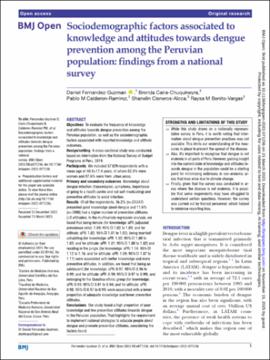
| dc.description.abstract | Objectives To evaluate the frequency of knowledge and attitudes towards dengue prevention among the Peruvian population, as well as the sociodemographic factors associated with reported knowledge and attitude outcomes. Design/setting A cross-sectional study was conducted, based on information from the National Survey of Budget Programs of Peru, 2019. Participants We included 57 829 respondents with a mean age of 40.3±17.4 years, of whom 52.8% were women and 87.6% were from urban areas. Primary and secondary outcomes Knowledge about dengue infection (transmission, symptoms, importance of going to a health centre and not self-medicating) and preventive attitudes to avoid infection. Results Of all the respondents, 36.2% (n=23 247) presented good knowledge about dengue and 11.6% (n=7890) had a higher number of preventive attitudes (≥3 attitudes). In the multivariate regression analysis, we found that being female (for knowledge: aPR (adjusted prevalence ratio): 1.03; 95% CI 1.02 to 1.03; and for attitude: aPR: 1.02; 95% CI 1.01 to 1.02), being married/cohabiting (for knowledge: aPR: 1.02; 95% CI 1.00 to 1.03; and for attitude: aPR: 1.01; 95% CI 1.00 to 1.02) and residing in the jungle (for knowledge: aPR: 1.14; 95% CI 1.12 to 1.16; and for attitude: aPR: 1.09; 95% CI 1.07 to 1.11) were associated with better knowledge and more preventive attitudes. In addition, we found that being an adolescent (for knowledge: aPR: 0.97; 95% CI 0.96 to 0.99; and for attitude: aPR: 0.99; 95% CI 0.97 to 0.99), and belonging to the Quechua ethnic group (for knowledge: aPR: 0.93; 95% CI 0.91 to 0.94; and for attitude: aPR: 0.98; 95% CI 0.97 to 0.99) were associated with a lower proportion of adequate knowledge and fewer preventive attitudes. Conclusions Our study found a high proportion of poor knowledge and few preventive attitudes towards dengue in the Peruvian population. That highlights the requirement to implement national strategies to educate people about dengue and promote preventive attitudes, considering the factors found. | en_US |
| dc.format | application/pdf | |
| dc.language.iso | eng | |
| dc.publisher | BMJ Publishing Group | |
| dc.relation.ispartof | urn:issn:2044-6055 | |
| dc.rights | https://purl.org/coar/access_right/c_abf2 | |
| dc.rights.uri | https://creativecommons.org/licenses/by-nc-sa/4.0/ | |
| dc.subject | SDG 3 | en_US |
| dc.subject | Dengue and Zika Virus Dynamics in Public Health | en_US |
| dc.subject | Community Knowledge and Practices in Dengue Control | en_US |
| dc.title | Sociodemographic factors associated to knowledge and attitudes towards dengue prevention among the Peruvian population: findings from a national survey | en_US |
| dc.type | https://purl.org/coar/resource_type/c_2df8fbb1 | |
| dc.identifier.doi | https://doi.org/10.1136/bmjopen-2022-071236 | |
| dc.subject.ocde | https://purl.org/pe-repo/ocde/ford#3.03.09 | |
| dc.type.other | Research article | |
| dc.identifier.journal | BMJ Open | |
| dc.type.version | https://purl.org/coar/version/c_970fb48d4fbd8a85 |
Files in this item
This item appears in the following Collection(s)
-
Artículos de Investigación [1294]

Except where otherwise noted, this item's license is described as https://purl.org/coar/access_right/c_abf2