Cervical cancer mortality in Peru: regional trend analysis from 2008–2017
| dc.contributor.author | Torres-Roman, J.S. | |
| dc.contributor.author | Ronceros-Cardenas, L. | |
| dc.contributor.author | Valcarcel, B. | |
| dc.contributor.author | Arce-Huamani, M.A. | |
| dc.contributor.author | Bazalar-Palacios, J. | |
| dc.contributor.author | Ybaseta-Medina, J. | |
| dc.contributor.author | La Vecchia, C. | |
| dc.contributor.author | Alvarez, C.S. | |
| dc.date.accessioned | 2025-10-31T18:33:30Z | |
| dc.date.available | 2025-10-31T18:33:30Z | |
| dc.date.issued | 2021 | |
| dc.identifier.uri | https://hdl.handle.net/20.500.12805/4955 | |
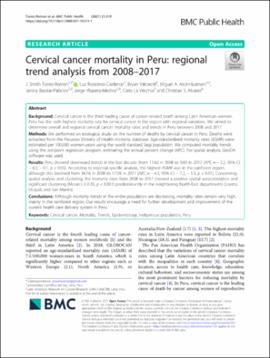
| dc.description.abstract | Background: Cervical cancer is the third leading cause of cancer-related death among Latin American women. Peru has the sixth highest mortality rate for cervical cancer in the region with regional variations. We aimed to determine overall and regional cervical cancer mortality rates and trends in Peru between 2008 and 2017. Methods: We performed an ecological study on the number of deaths by cervical cancer in Peru. Deaths were extracted from the Peruvian Ministry of Health mortality database. Age-standardized mortality rates (ASMR) were estimated per 100,000 women-years using the world standard Segi population. We computed mortality trends using the Joinpoint regression program, estimating the annual percent change (APC). For spatial analysis, GeoDA software was used. Results: Peru showed downward trends in the last decade (from 11.62 in 2008 to 9.69 in 2017 (APC = − 2.2, 95% CI: − 4.3, − 0.1, p < 0.05). According to regional-specific analysis, the highest ASMR was in the rainforest region, although this declined from 34.16 in 2008 to 17.98 in 2017 (APC = − 4.3, 95% CI: − 7.2, − 1.3, p < 0.01). Concerning spatial analysis and clustering, the mortality rates from 2008 to 2017 showed a positive spatial autocorrelation and significant clustering (Moran’s I: 0.35, p < 0.001) predominantly in the neighboring North-East departments (Loreto, Ucayali, and San Martin). Conclusions: Although mortality trends in the entire population are decreasing, mortality rates remain very high, mainly in the rainforest region. Our results encourage a need for further development and improvement of the current health care delivery system in Peru. | en_US |
| dc.format | application/pdf | |
| dc.language.iso | eng | |
| dc.publisher | BioMed Central | |
| dc.relation.ispartof | urn:issn:1471-2458 | |
| dc.rights | https://purl.org/coar/access_right/c_abf2 | |
| dc.rights.uri | https://creativecommons.org/licenses/by-nc-sa/4.0/ | |
| dc.subject | SDG 3 | en_US |
| dc.subject | Breast Cancer Screening and Health Disparities | en_US |
| dc.subject | Trends in Cancer Mortality Across Regions | en_US |
| dc.title | Cervical cancer mortality in Peru: regional trend analysis from 2008–2017 | en_US |
| dc.type | https://purl.org/coar/resource_type/c_2df8fbb1 | |
| dc.identifier.doi | https://doi.org/10.1186/s12889-021-10274-1 | |
| dc.subject.ocde | https://purl.org/pe-repo/ocde/ford#3.03.05 | |
| dc.type.other | Research article | |
| dc.identifier.journal | BMC Public Health | |
| dc.type.version | https://purl.org/coar/version/c_970fb48d4fbd8a85 |
Files in this item
This item appears in the following Collection(s)
-
Artículos de Investigación [1294]

Except where otherwise noted, this item's license is described as https://purl.org/coar/access_right/c_abf2