Disparities in breast cancer mortality among Latin American women: trends and predictions for 2030
| dc.contributor.author | Torres-Román, J.S. | |
| dc.contributor.author | Ybaseta-Medina, J. | |
| dc.contributor.author | Loli-Guevara, S. | |
| dc.contributor.author | Bazalar-Palacios, J. | |
| dc.contributor.author | Valcarcel, B. | |
| dc.contributor.author | Arce-Huamani, M.A. | |
| dc.contributor.author | Alvarez, C.S. | |
| dc.contributor.author | Hurtado-Roca, Y. | |
| dc.date.accessioned | 2025-10-31T18:33:29Z | |
| dc.date.available | 2025-10-31T18:33:29Z | |
| dc.date.issued | 2023 | |
| dc.identifier.uri | https://hdl.handle.net/20.500.12805/4951 | |
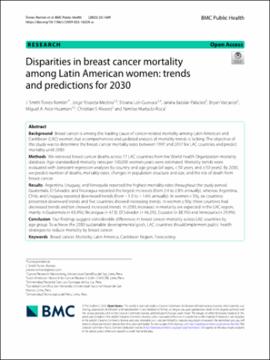
| dc.description.abstract | Background: Breast cancer is among the leading cause of cancer-related mortality among Latin American and Caribbean (LAC) women, but a comprehensive and updated analysis of mortality trends is lacking. The objective of this study was to determine the breast cancer mortality rates between 1997 and 2017 for LAC countries and predict mortality until 2030. Methods: We retrieved breast cancer deaths across 17 LAC countries from the World Health Organization mortality database. Age-standardized mortality rates per 100,000 women-years were estimated. Mortality trends were evaluated with Joinpoint regression analyses by country and age group (all ages, < 50 years, and ≥ 50 years). By 2030, we predict number of deaths, mortality rates, changes in population structure and size, and the risk of death from breast cancer. Results: Argentina, Uruguay, and Venezuela reported the highest mortality rates throughout the study period. Guatemala, El Salvador, and Nicaragua reported the largest increases (from 2.4 to 2.8% annually), whereas Argentina, Chile, and Uruguay reported downward trends (from − 1.0 to − 1.6% annually). In women < 50y, six countries presented downward trends and five countries showed increasing trends. In women ≥ 50y, three countries had decreased trends and ten showed increased trends. In 2030, increases in mortality are expected in the LAC region, mainly in Guatemala (+ 63.0%), Nicaragua (+ 47.3), El Salvador (+ 46.2%), Ecuador (+ 38.5%) and Venezuela (+ 29.9%). Conclusion: Our findings suggest considerable differences in breast cancer mortality across LAC countries by age group. To achieve the 2030 sustainable developmental goals, LAC countries should implement public health strategies to reduce mortality by breast cancer. | en_US |
| dc.description.sponsorship | This research work has been funded by Universidad Cientifica del Sur (Concurso de fondos Beca Cabieses, Resolución Directoral N° 011-DGIDI-CIENTÍFICA-2021). | |
| dc.format | application/pdf | |
| dc.language.iso | eng | |
| dc.publisher | BioMed Central | |
| dc.relation.ispartof | urn:issn:1471-2458 | |
| dc.rights | https://purl.org/coar/access_right/c_abf2 | |
| dc.rights.uri | https://creativecommons.org/licenses/by-nc-sa/4.0/ | |
| dc.subject | SDG 3 | en_US |
| dc.subject | Breast Cancer Screening and Health Disparities | en_US |
| dc.subject | Breast Cancer Care and Awareness in Africa | en_US |
| dc.title | Disparities in breast cancer mortality among Latin American women: trends and predictions for 2030 | en_US |
| dc.type | https://purl.org/coar/resource_type/c_2df8fbb1 | |
| dc.identifier.doi | https://doi.org/10.1186/s12889-023-16328-w | |
| dc.subject.ocde | https://purl.org/pe-repo/ocde/ford#3.02.21 | |
| dc.type.other | Research article | |
| dc.identifier.journal | BMC Public Health | |
| dc.type.version | https://purl.org/coar/version/c_970fb48d4fbd8a85 |
Files in this item
This item appears in the following Collection(s)
-
Artículos de Investigación [1294]

Except where otherwise noted, this item's license is described as https://purl.org/coar/access_right/c_abf2