Homicide in Chile: Trends 2000 - 2012
| dc.contributor.author | Otzen, T. | |
| dc.contributor.author | Sanhueza, A. | |
| dc.contributor.author | Manterola, C. | |
| dc.contributor.author | Hetz, M. | |
| dc.contributor.author | Melnik, T. | |
| dc.date.accessioned | 2025-10-31T18:33:28Z | |
| dc.date.available | 2025-10-31T18:33:28Z | |
| dc.date.issued | 2015 | |
| dc.identifier.uri | https://hdl.handle.net/20.500.12805/4947 | |
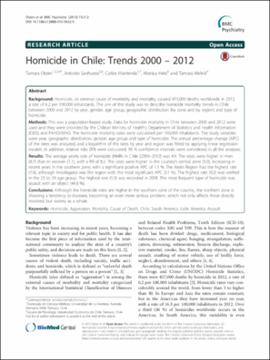
| dc.description.abstract | Background: Homicide, an external cause of morbidity and mortality, caused 473,000 deaths worldwide in 2012, a rate of 6.2 per 100,000 inhabitants. The aim of this study was to describe homicide mortality trends in Chile between 2000 and 2012 by year, gender, age group, geographic distribution (by zone and by region) and type of homicide. Methods: This was a population-based study. Data for homicide mortality in Chile between 2000 and 2012 were used and they were provided by the Chilean Ministry of Health's Department of Statistics and Health Information (DEIS) and PAHO/WHO. The homicide mortality rates were calculated per 100,000 inhabitants. The study variables were year, geographic distribution, gender, age group and type of homicide. The annual percentage change (APC) of the rates was analyzed, and a logarithm of the rates by year and region was fitted by applying linear regression models. In addition, relative risks (RR) were calculated. 95 % confidence intervals were considered in all the analyses. Results: The average yearly rate of homicide (HMR) in Chile (2000-2012) was 4.9. The rates were higher in men (8.7) than in women (1.1), with a RR of 8.2. The rates were higher in the country's central zone (5.0), increasing in recent years in the southern zone, with a significant positive APC of 1.1 %. The Aisén Region had the highest rate (7.6), although Antofagasta was the region with the most significant APC (3.1 %). The highest rate (9.2) was verified in the 25 to 39 age group. The highest rate (5.5) was recorded in 2005. The most frequent type of homicide was assault with an object (44.8 %). Conclusions: Although the homicide rates are higher in the southern zone of the country, the northern zone is showing a tendency to increase, becoming an even more serious problem, which not only affects those directly involved, but society as a whole. | en_US |
| dc.format | application/pdf | |
| dc.language.iso | eng | |
| dc.publisher | BioMed Central | |
| dc.relation.ispartof | urn:issn:1471-244X | |
| dc.rights | https://purl.org/coar/access_right/c_abf2 | |
| dc.rights.uri | https://creativecommons.org/licenses/by-nc-sa/4.0/ | |
| dc.subject | SDG 16 | en_US |
| dc.subject | Traffic Safety Models and Pedestrian Behavior Insights | en_US |
| dc.subject | Road Traffic Safety and Economic Implications | en_US |
| dc.title | Homicide in Chile: Trends 2000 - 2012 | en_US |
| dc.type | https://purl.org/coar/resource_type/c_2df8fbb1 | |
| dc.identifier.doi | https://doi.org/10.1186/s12888-015-0632-5 | |
| dc.subject.ocde | https://purl.org/pe-repo/ocde/ford#5.04.00 | |
| dc.type.other | Research article | |
| dc.identifier.journal | BMC Psychiatry | |
| dc.type.version | https://purl.org/coar/version/c_970fb48d4fbd8a85 |
Files in this item
This item appears in the following Collection(s)
-
Artículos de Investigación [1294]

Except where otherwise noted, this item's license is described as https://purl.org/coar/access_right/c_abf2