Self-reported perceptions and knowledge of telemedicine in medical students and professionals who enrolled in an online course in Peru
| dc.contributor.author | García-Gutiérrez, F.M. | |
| dc.contributor.author | Pino-Zavaleta, F. | |
| dc.contributor.author | Romero-Robles, M.A. | |
| dc.contributor.author | Patiño-Villena, A.F. | |
| dc.contributor.author | Jauregui-Cornejo, A.S. | |
| dc.contributor.author | Benites-Bullón, A. | |
| dc.contributor.author | Goméz-Mendoza, A. | |
| dc.contributor.author | Alarcon-Ruiz, C.A. | |
| dc.contributor.author | Huapaya-Huertas, O. | |
| dc.date.accessioned | 2025-10-31T18:33:26Z | |
| dc.date.available | 2025-10-31T18:33:26Z | |
| dc.date.issued | 2023 | |
| dc.identifier.uri | https://hdl.handle.net/20.500.12805/4939 | |
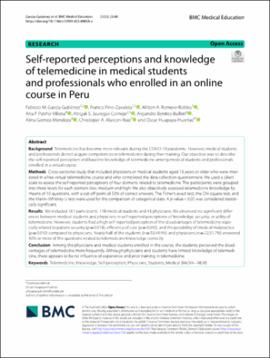
| dc.description.abstract | Background: Telemedicine has become more relevant during the COVID-19 pandemic. However, medical students and professionals do not acquire competences in telemedicine during their training. Our objective was to describe the self-reported perception and baseline knowledge of telemedicine among medical students and professionals enrolled in a virtual course. Methods: Cross-sectional study that included physicians or medical students aged 18 years or older who were interested in a free virtual telemedicine course and who completed the data collection questionnaire. We used a Likert scale to assess the self-reported perceptions of four domains related to telemedicine. The participants were grouped into three levels for each domain: low, medium and high. We also objectively assessed telemedicine knowledge by means of 10 questions, with a cut-off point of 50% of correct answers. The Fisher's exact test, the Chi-square test, and the Mann–Whitney U test were used for the comparison of categorical data. A p-value < 0.05 was considered statistically significant. Results: We included 161 participants: 118 medical students and 43 physicians. We observed no significant differences between medical students and physicians in self-reported perceptions of knowledge, security, or utility of telemedicine. However, students had a high self-reported perception of the disadvantages of telemedicine especially related to patient security (p = 0.018), efficiency of care (p = 0.040), and the possibility of medical malpractice (p = 0.010) compared to physicians. Nearly half of the students (n = 53,44.9%) and physicians (n = 22,51.7%) answered 50% or more of the questions related to telemedicine knowledge correctly. Conclusion: Among the physicians and medical students enrolled in the course, the students perceived the disadvantages of telemedicine more frequently. Although physicians and students have limited knowledge of telemedicine, there appears to be no influence of experience and prior training in telemedicine. | en_US |
| dc.description.sponsorship | Open Access funding enabled and organized by Projekt DEAL. The review was conducted as part of the Bavarian project network BayUFP “Measurement, Characterization and Assessment of Ultrafine Particles,” which is funded by the Bavarian State Ministry of the Environment and Consumer Protection ( http://www.stmuv.bayern.de ). The funders had no role in the design of the review, collection, analysis, interpretation of the data, or preparation of the manuscript. | |
| dc.format | application/pdf | |
| dc.language.iso | eng | |
| dc.publisher | BioMed Central | |
| dc.relation.ispartof | urn:issn:1472-6920 | |
| dc.rights | https://purl.org/coar/access_right/c_abf2 | |
| dc.rights.uri | https://creativecommons.org/licenses/by-nc-sa/4.0/ | |
| dc.subject | Telemedicine's Role in Transforming Healthcare Access | en_US |
| dc.subject | Telemedicine Integration and Healthcare Transformation | en_US |
| dc.title | Self-reported perceptions and knowledge of telemedicine in medical students and professionals who enrolled in an online course in Peru | en_US |
| dc.type | https://purl.org/coar/resource_type/c_2df8fbb1 | |
| dc.identifier.doi | https://doi.org/10.1186/s12909-023-04058-x | |
| dc.subject.ocde | https://purl.org/pe-repo/ocde/ford#3.00.00 | |
| dc.type.other | Research article | |
| dc.identifier.journal | BMC Medical Education | |
| dc.type.version | https://purl.org/coar/version/c_970fb48d4fbd8a85 |
Files in this item
This item appears in the following Collection(s)
-
Artículos de Investigación [1294]

Except where otherwise noted, this item's license is described as https://purl.org/coar/access_right/c_abf2