Second-hand smoking, hypertension and cardiovascular risk: findings from Peru
| dc.contributor.author | Bernabe-Ortiz, A. | |
| dc.contributor.author | Carrillo-Larco, R.M. | |
| dc.date.accessioned | 2025-10-31T18:33:25Z | |
| dc.date.available | 2025-10-31T18:33:25Z | |
| dc.date.issued | 2021 | |
| dc.identifier.uri | https://hdl.handle.net/20.500.12805/4937 | |
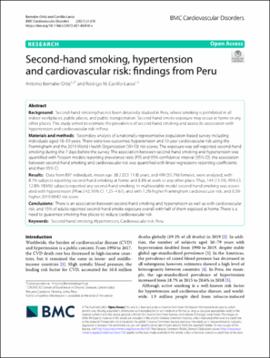
| dc.description.abstract | Background: Second-hand smoking has not been detailedly studied in Peru, where smoking is prohibited in all indoor workplaces, public places, and public transportation. Second-hand smoke exposure may occur at home or any other places. This study aimed to estimate the prevalence of second-hand smoking and assess its association with hypertension and cardiovascular risk in Peru. Materials and methods: Secondary analysis of a nationally-representative population-based survey including individuals aged 18–59 years. There were two outcomes: hypertension and 10-year cardiovascular risk using the Framingham and the 2019 World Health Organization (WHO) risk scores. The exposure was self-reported second-hand smoking during the 7 days before the survey. The association between second-hand smoking and hypertension was quantified with Poisson models reporting prevalence ratio (PR) and 95% confidence interval (95% CI); the association between second-hand smoking and cardiovascular risk was quantified with linear regressions reporting coefficients and their 95% CI. Results: Data from 897 individuals, mean age: 38.2 (SD: 11.8) years, and 499 (55.7%) females, were analyzed, with 8.7% subjects reporting second-hand smoking at home and 8.3% at work or any other place. Thus, 144 (15.5%; 95% CI: 12.8%-18.6%) subjects reported any second-hand smoking. In multivariable model second-hand smoking was associated with hypertension (PR = 2.42; 95% CI: 1.25–4.67), and with 1.2% higher Framingham cardiovascular risk, and 0.2% higher 2019 WHO risk score. Conclusions: There is an association between second-hand smoking and hypertension as well as with cardiovascular risk, and 15% of adults reported second-hand smoke exposure overall with half of them exposed at home. There is a need to guarantee smoking-free places to reduce cardiovascular risk. | en_US |
| dc.description.sponsorship | RMC-L is funded by a Wellcome Trust International Training Fellowship (214185/Z/18/Z). The funders had no role in the preparation of the manuscript, or the decision to publish. | |
| dc.format | application/pdf | |
| dc.language.iso | eng | |
| dc.publisher | BioMed Central | |
| dc.relation.ispartof | urn:issn:1471-2261 | |
| dc.rights | https://purl.org/coar/access_right/c_abf2 | |
| dc.rights.uri | https://creativecommons.org/licenses/by-nc-sa/4.0/ | |
| dc.subject | SDG 11 | en_US |
| dc.subject | Cardiovascular Monitoring and Neonatal Care | en_US |
| dc.subject | Health Risks of Passive Smoking Exposure | en_US |
| dc.title | Second-hand smoking, hypertension and cardiovascular risk: findings from Peru | en_US |
| dc.type | https://purl.org/coar/resource_type/c_2df8fbb1 | |
| dc.identifier.doi | https://doi.org/10.1186/s12872-021-02410-x | |
| dc.subject.ocde | https://purl.org/pe-repo/ocde/ford#3.03.00 | |
| dc.type.other | Research article | |
| dc.identifier.journal | BMC Cardiovascular Disorders | |
| dc.type.version | https://purl.org/coar/version/c_970fb48d4fbd8a85 |
Files in this item
This item appears in the following Collection(s)
-
Artículos de Investigación [1294]

Except where otherwise noted, this item's license is described as https://purl.org/coar/access_right/c_abf2